|
|


 |
|
|
|
|

|
List Reviews Non-fiction Films |
In
2008 I celebrated 10 years of Fictional Cities with
a new city, but it's not included in the main
menu as when I did so it seemed wrong, in some indefinable way. It could be just
the disturbance of change, but others shared my disquiet. It can be accessed
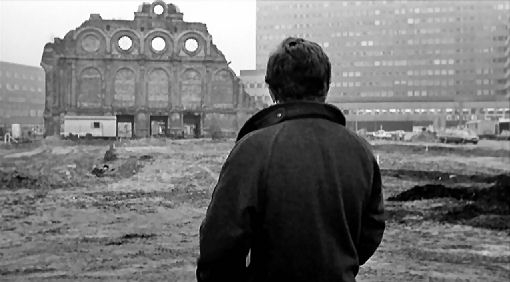
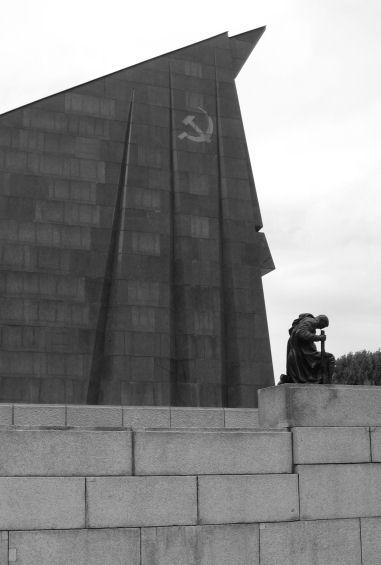
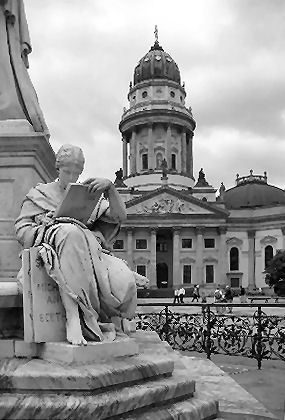
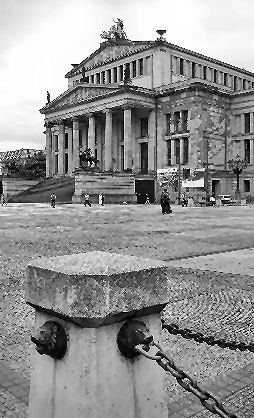
from the back-up text menus at the bottom of each page. This page was prompted by a visit to Berlin in July 2008. The city's past exists mostly in words - the understandable desire to wipe out evidence of the city's recent history means that there's very little physical evidence left of the city's grim 20th century. Which makes sources of mental pictures somewhat essential. The years after the rush of enthusiasm in 2008 didn't see many updates, I'm afraid, but my second visit in October 2015 saw a bit of freshening, as did my third in 2024. And then in May 2025 came two new zeitgeisty novels set in Berlin, one shortlisted for the International Booker Prize, read for untopographical reasons. (I'm sorry if the monochrome tendency seems a little melodramatic - it's just that all the films I watched were b&w, even the modern ones, so I went with it.) |
| Chloe Aridjis
Book of
Clouds Paul Beatty Slumberland Rebecca Cantrell A Trace of Smoke A Night of Long Knives A Game of Lies Beatrice Colin The Luminous Life of Lilly Aphrodite Helen Constantine (ed.) Berlin Tales Len Deighton Funeral in Berlin Winter: A Berlin Family, 1899-1945 Berlin Game Alfred Doblin Berlin Alexanderplatz David Downing Zoo Station Silesian Station Stettin Station Potsdam Station Lehrter Station Hans Fallada Alone in Berlin Ariana Franklin City of Shadows Pierre Frei Berlin: a novel Paul Grossman The Sleepwalkers Robert Harris Fatherland Ida Hattemer-Higgins The History of History |
|
|
 |
Christopher Isherwood The Berlin Novels: Mr Norris Changes Trains; Goodbye to Berlin Joseph Kanon The Good German Leaving Berlin Phillip Kerr The Bernie Gunther series: The Berlin Noir trilogy: (March Violets; The Pale Criminal; A German Requiem) The One from the Other A Quiet Flame (set in Buenos Aires) If the Dead Rise Not (Gunther's back story, set in 1934) Field Gray Prague Fatale (set in Prague!) Vincenzo Latronico Perfection Gregory Lee Berlin: Day Zero Ian McEwan The Innocent Vladimir Nabokov The Gift Laughter in the Dark Mary Piers Paul Read Patriot in Berlin Michael Pye The Pieces from Berlin Sven Regener Berlin Blues Vikram Seth Two lives Walser, Robert Berlin Stories Zink, Nell Sister Europe |
|
Chloe Aridjis Book of
Clouds Well here's refreshing - a novel about Berlin that's not a thriller. And make no mistake, this is a book about Berlin, not just a book set there. Tatiana from Mexico is living in Berlin and getting what work she can, when she is put in touch with an elderly historian who wants her to type up the tapes on which he monologues about aspects of Berlin's recent history and how events inhabit the city's spaces. So Tatiana's life and wanderings through the city are shadowed by the historian's observations as her friendship with him develops. It's all very Berlin, and a quick and easy yet stimulating and resonant read. The city is recognisable but mysterious and one of the themes of the novel is vacancy - what's not there being as important as what is. This is truly one of those rare books that stimulates heart and head equally. Len Deighton Funeral in Berlin My first Len Deighton, and the style strikes as pacey but overloaded with detail and a bit padded generally. You get used to it, but describing every room, for example, down to the lino pattern, stains and individual pieces of dirty washing and boxes of washing powder gets a bit wearing. Good sharp and witty dialogue, though, and cynicism and double-dealing a-go-go. Berlin looks and smells and feels authentic and period, and it's where most of the action takes place. There's London life too. Very much of its time, but enjoyable for that reason. I'm not enthused to read another one though. Hans Fallada Alone in Berlin This one cropped up up in a fair few lists of end-of-year recommendations when it was republished in 2009, which took me back to the 1980s, when I'd spent much time at work grubbing around in my library's fiction reserve stock, rooting out such forgotten gems as the works of Hans Fallada. The book was originally published in 1947, the year Fallada died, and has been translated into English before, but this is a new translation, by Michael Hoffman. The novel tells of an elderly couple's sudden disaffection with the Nazi regime, brought about by the death of their son, and how their decision to protest affects and, let's face it, drastically shortens their lives and the lives of those around them. Criminal and Nazi neighbours, policemen, friends, relatives...all are swept to their doom by the couple's decision. And the fact that their chosen form of protest - the leaving in public stairwells of postcards with rabble-rousing anti-government messages written on them - is ineffectual in the extreme lessens the subsequent brutality not a bit. It's a marvellously humane and involving book, though, and a riot of nuance and ambiguity. Not a single note jars either - this is a book you cannot but believe in, and which was based upon the exploits of a real-life couple. You no more doubt that life in Berlin in the 1940s is here truthfully evoked than you doubt that people would behave as they do in these situations. A genuine masterpiece. Ariana Franklin City of Shadows The setting here is Berlin in the early 1920s. Germany has lost the 1914-18 war and is now losing the peace. Inflation  is rampant
and the streets are empty of people, who can't afford to go out, but full
of thugs and violence. One of the few people growing fat on the collapse
is Prince Nick, the owner of various profitable nightclubs of ill repute.
When he hears of a woman in an asylum who thinks she's Anastasia, the secret
survivor of the massacre of the Russian czar's family, he decides to
acquire her and groom her. The plan involves his secretary Esther - a Jew
and a pogrom survivor with a hideous scar on one side of her face and too
much wit and initiative to sink comfortably into her role. Then people
start to get murdered and 'Anastasia''s suspicions of a man who lurks in
forests and follows her have to be taken seriously. The final essential
character, a policeman with shadows of his own, now gets involved, in more
ways than one. There's a lot of plot going on here, not fast but dense,
and a lot of history (real and imagined) slipped into the action easily and readably. Smooth,
convincing, and confidently evocative of the city in another of its
tragic decades. is rampant
and the streets are empty of people, who can't afford to go out, but full
of thugs and violence. One of the few people growing fat on the collapse
is Prince Nick, the owner of various profitable nightclubs of ill repute.
When he hears of a woman in an asylum who thinks she's Anastasia, the secret
survivor of the massacre of the Russian czar's family, he decides to
acquire her and groom her. The plan involves his secretary Esther - a Jew
and a pogrom survivor with a hideous scar on one side of her face and too
much wit and initiative to sink comfortably into her role. Then people
start to get murdered and 'Anastasia''s suspicions of a man who lurks in
forests and follows her have to be taken seriously. The final essential
character, a policeman with shadows of his own, now gets involved, in more
ways than one. There's a lot of plot going on here, not fast but dense,
and a lot of history (real and imagined) slipped into the action easily and readably. Smooth,
convincing, and confidently evocative of the city in another of its
tragic decades.Paul Grossman The Sleepwalkers This covers not uncommon ground, being about a cop uncovering twisty plots and nasty experiments in early-30s Berlin. But the cop here is Jewish, and also famous for having solved the Child Eater case (shades of M) which makes him less easy pickings for the Nazis. A lot of famous faces appear (like Freud, Fritz Lang and Marlene Dietrich) somewhat gratuitously, in bars and at parties, but this is basically a tightly-plotted and atmospheric thriller-trip through familiar territory. The evocation of Berlin in 1932 is what sets it apart, though - the locations and bright lights leap into your imagination with telling detail and a feeling of authenticity. A good solid gripping read, then, and a true treat for those wanting to soak up Weimar Berlin. |
Christopher Isherwood The
Berlin Stories
|
|
| Maik Kopleck Past Finder - Berlin 1933-45 Past Finder - Berlin 1945-89 A matching pair of specialist guidebooks covering the war and the wall, basically. Both cover their ground efficiently and widely and are very smartly designed with good use of copious illustrations. They tell you where to go to find the scant traces and also give good background. They are both translated from the German, the first one with more style and smoothness than the second. Easy to find in Berlin, but not elsewhere. 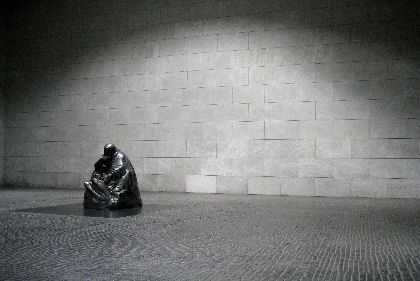 |
Brian Ladd The Ghosts of Berlin - Confronting German
History in the Urban Landscape A mind-boggling investigation of the arguments that developed around the demolishing, renovating or rebuilding of Berlin's many contentious buildings, statues, and even commemorative plaques. When your recent history is so awful it's tempting to reach back to a time before, but to do so stirs up feelings and meaning too, as it can be argued that this period was what created the atmosphere for the way things developed. Not all the arguments and topics go in such a circular way, but this is all fraught and thought-provoking stuff. Heather Reyes and Katy Derbyshire eds. city-lit Berlin Another in this sterling series of city-themed compilations, this one follows the pattern of short excerpts gathered into chapters, that this time vary from the arbitrary to the perfect. The simplest one is also the most gripping: it's called The past is another country, but don't let that put you off. Its well-chosen pieces take you through Berlin's history from the early 19th Century to today, and make for an almost perfect, and very moving, slice through history. (It's interesting to note that even in the 1920s Berlin was a place renowned for building over its history.) The book choices are as eclectic as you could wish for, taking in most of the authors listed above - including the obvious choices like Isherwood, Kerr, Le Carre and Deighton - and some stuff new to me I'll be delving deeper into soon. Top of the list of latter include Ian Walker's Zoo Station and Beatrice Collin's The Luminous Life of Lilly Aphrodite. Further interest is added by co-editor Katy Derbyshire's translations of bits from works not otherwise available in English. This manages to be not just a fine and fascinating introduction to the literature, but to rise above its expected status as a dipping thing to become a mighty fine cover-to-cover read in itself. Ian J Sanders The Ghosts of Berlin - Images of a divided city The is something of a vanity-published book. The author is responsible for berlinphotos.co.uk and seems to have decided to put his site into print. (Just as well as it is now an ex-website) The result is an uncheap floppy paperback full of black and white photos that are bleakly evocative of the place and time, but not reproduced to a very high quality, probably because they are derived from the colour originals once viewable on the site. |
|
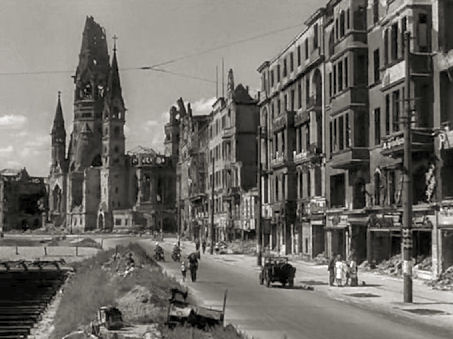
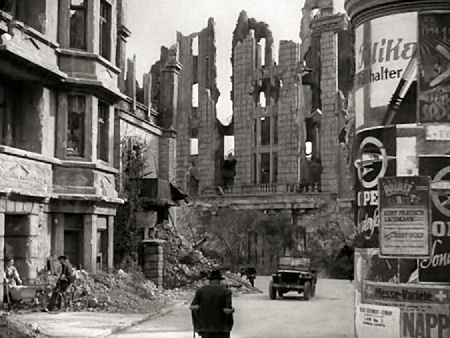
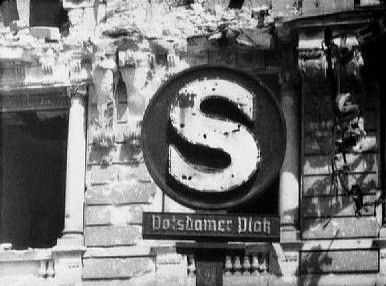
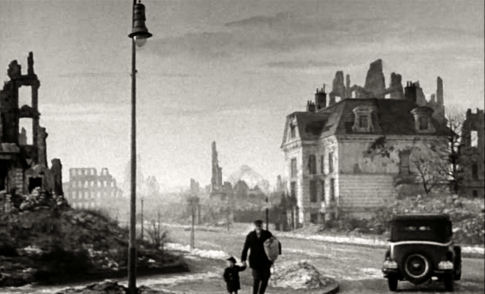
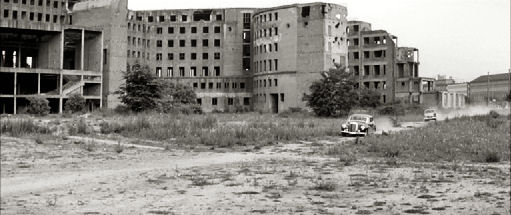
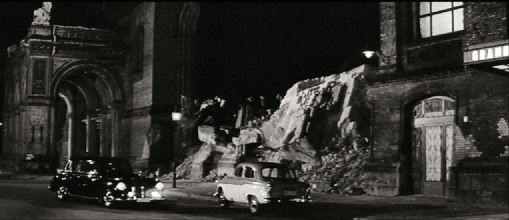
A2Z Aimée & Jaguar Berlin: Symphony of a Great City 1927 A day in the life of a city, with the streets, factories, cafes and people of Berlin filmed in an artless way in 1927, and made into something more arty by the addition of music and by the editing. This can't help but be a fascinating portrait of a city on the brink of so much and there's more than enough strangeness and ordinariness to hold the attention for its short length. Berlin Alexanderplatz Alfred Döblin's novel has been filmed twice. The first was in 1931 with Döblin himself working on the adaptation. The second was Fassbinder's marathon 15+ hour German TV adaptation from 1980. The Big Lift About the Berlin airlift. Cabaret Christiane F. The Counterfeiters Cycling the Frame Cynthia Beatts' documentary of 1988, featuring Tilda Swinton cycling the wall, followed up in 2009 by The Invisible Frame. Dr. M Faraway, So Close! The sequel to Wings of Desire. A Foreign Affair 1948 Filmed in Berlin just after the war this is the story of a visiting congresswoman learning more than she bargained for about the temptations and opportunities available to the occupying forces. The congresswoman is played by Jean Arthur and the soldier who shows her that all is not black and white is played by John Lund. The bar singer with the Nazi past here is Marlene Dietrich, and of course she has a 'dead' Nazi husband. The cynicism and sharp humour here are a joy, but clash somewhat with bursts of earnestness and bits of flag-waving. There are odd jarrings too in, for example, the jaunty music playing as our hero drives his jeep past the ruins to deliver a hard-won mattress to Marlene Dietrich (see screen-captures). The cynicism can sometimes smack of coldness, is what I'm getting at. But a fine film, with good footage from 1946, including aerial filming done by Wilder on a visit before the film was thought of. His next one was the wonderful Sunset Boulevard. Funeral in Berlin The second of a trio of Len Deighton adaptations starring Michael Caine. |
The Good German |
|
|
Helsinki-Napoli All Night Long |
|
|
|
Shining Through
|
|
|
|
|
||

Venice //
Florence //London
// Berlin
Home


 The Pale Criminal; A German Requiem