|
|


  |
|
|
|
|
|
|
|
|
|
This
Art
Pursuits
trip is entitled CRANACH Renaissance and Reformation in Art. Lucas
Cranach and Martin Luther's close friendship and supportive alliance was not
something I was aware of, but I was soon to become very enlightened. The first
two nights are spent in Wittenberg, but for the rest of the week we settle in
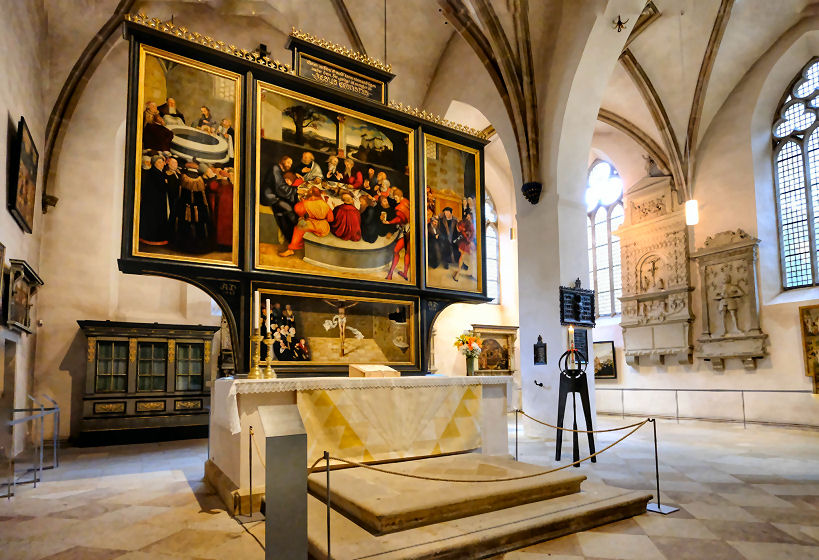
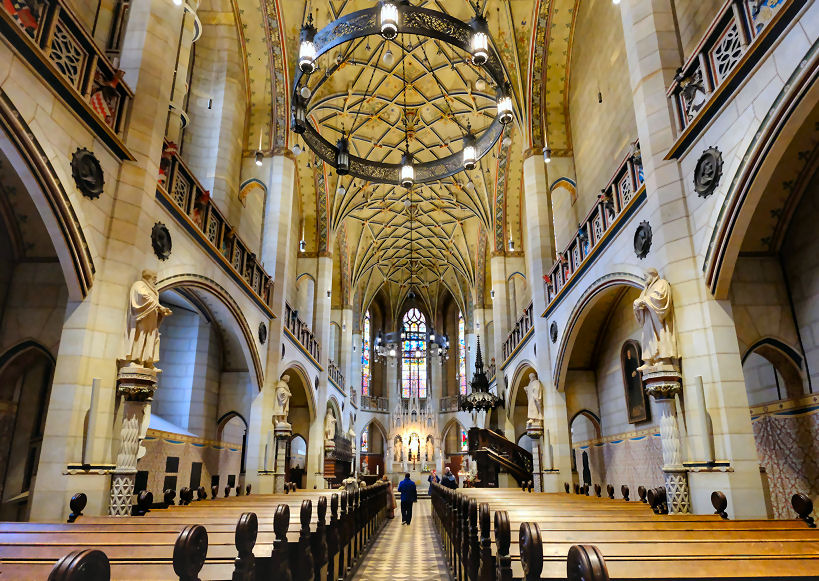
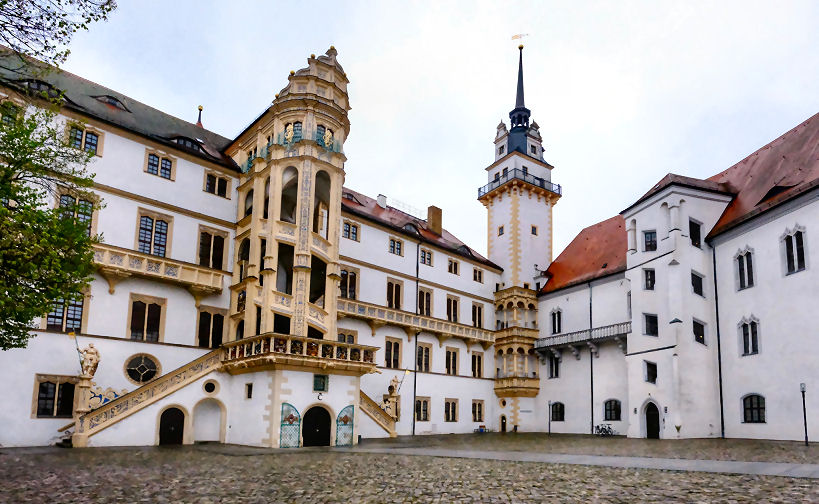
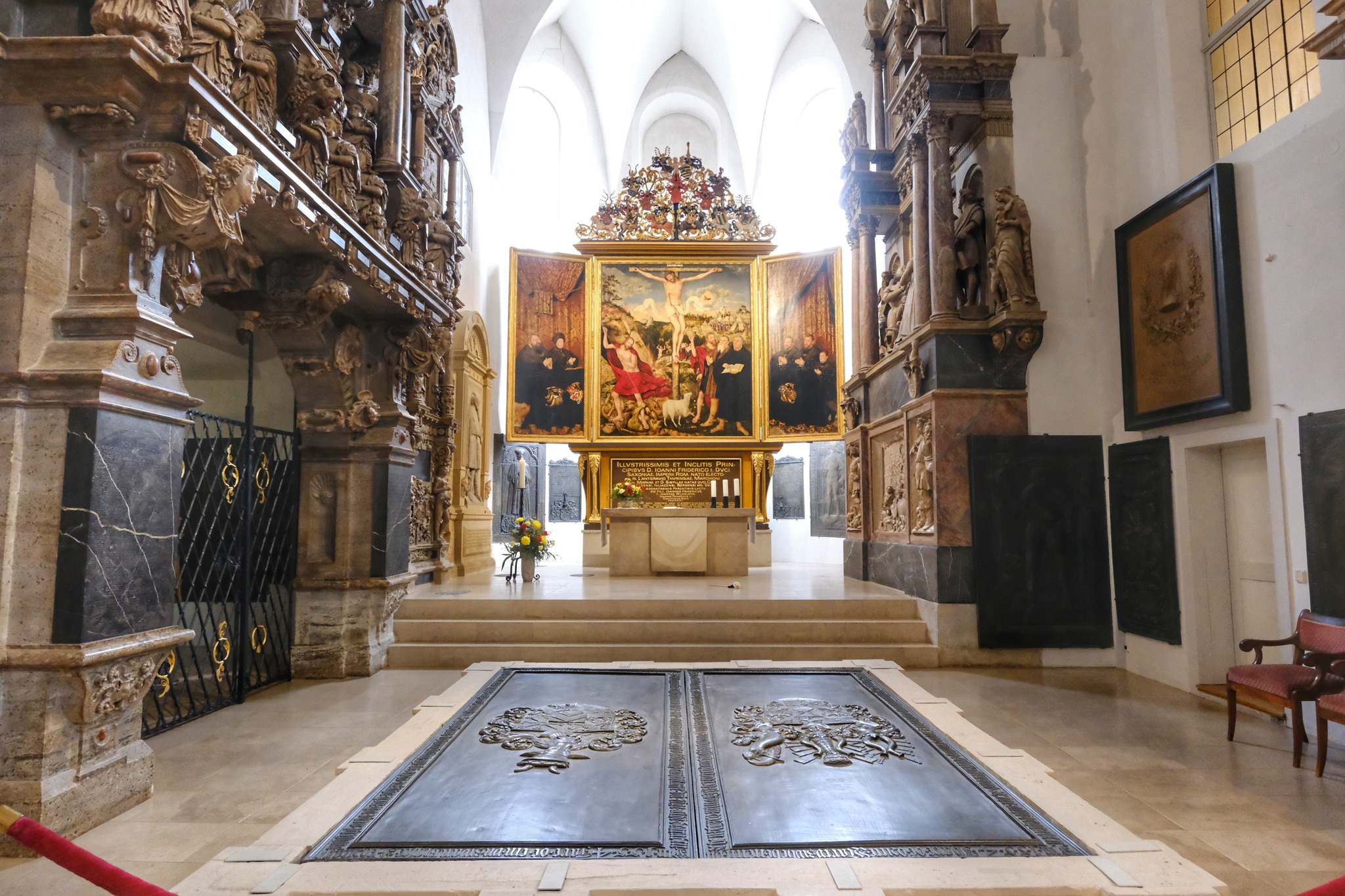
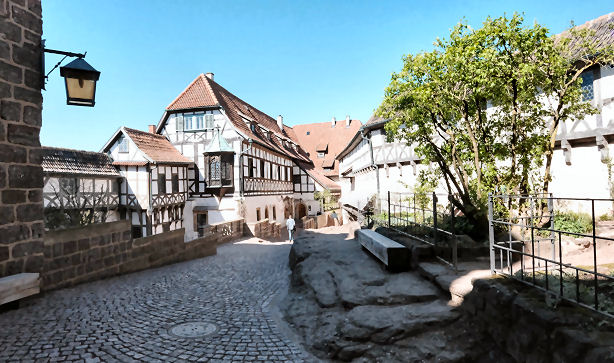
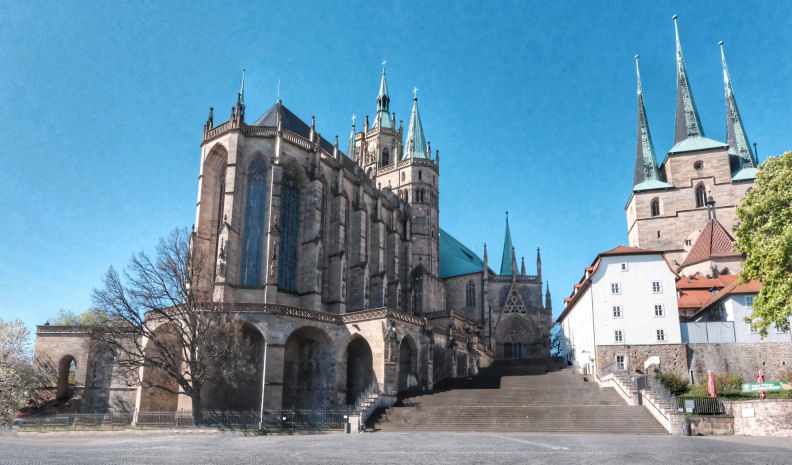
Weimar. Saturday 18th Overnight at the Heathrow Hilton, my alarm was set for 5.30, but I woke up at 20 past anyway. I took tube to Terminal 5, using my Freedom Pass as there's no rush hour at the weekend. Met Graham, the Art Pursuits rep, before 6.30 and was in the Pret with an Americano and almond croissant comfortably by twenty-to. There was no queuing and no crowds, which was nice, but then the flight was an hour late departing. A late arrival into Berlin Brandenburg airport resulted. The new EU passport business for non-members is still causing confusion and delay. I chose to ignore the ranks of machines as I'd already been registered in France in March and when I got to the desk I just had to present my fingers, and got a stamp anyway. Our group, of 11, were met by our lecturer, Ulrike Ziegler, in the arrivals hall and our coach took us north, and to the Best Western Soibelmanns in Wittenberg where we met up with Stephanie the tour manager, and got enroomed. After an hour to settle-in we gathered at 4.15 for an introductory walk to the Stadtkirche St Marien, the parish church where Luther preached and which has a large and impressive altarpiece by Cranach the elder, and his studio. It's very protestant, in its subject matter and lack of saints. Smaller Cranach panels surround it on the wall either side, amongst the wall memorials, some even more point-making. In the evening we met in hotel bar for welcome drinks (weissbier!) followed by our first dinner, in the hotel restaurant. A minimal mozzarella and tomato salad, a melange of mixed veg chunks for the veggies, and an odd black forest thing in a glass. The conversation was better. Sunday 19th Breakfast was fine: good juice and coffee, a good variety of cereals, including what I know, as a kid in the 70s, as Sugar Puffs, and good fresh croissants, enjoyed with a sharp forest fruits jam. Today we spent walking around Wittenberg, in varying strengths of rain, on the trail of Luther and his pals, including Cranach. We began at the Lutherhaus, which was the town’s Augustinian friary bur later became Luther’s home. The house itself is under restoration and closed, but it's highlight art and objects are in the modern museum across the courtyard. After a coffee (or hot chocolate) break. We then went up the street to the Melanchthon House, built in Renaissance style and the home of Luther's closest friend and ally. With more interesting stuff displayed in a modern museum style very similar to the Lutherhaus museum. After an independent lunch, spent by some of us in the Independent restaurant opposite our hotel - I had some special tomato soup - we strolled through some very wet rain to the Schlosskirche (Castle Church), where Luther and his pal Melankton are buried. It's got some medieval remainders but is mostly handsome 19th-century myth creation. For the evening's independent meal most of us went with Stephanie to the Tuscany restaurant for, for me, some more delicious tomato soup, a Margherita pizza with onion and a raspberry panna cotta. All good. Monday 20th After breakfast (which featured yesterday's croissants, I suspect) we checked out of the hotel and a coach took us to Torgau in the rain, which never really stopped today.  After a look at a war memorial we started off in the grand renaissance courtyard of the Hartenfels Palace. Created for John Frederick I, future Elector of Saxony, and Sybille of Cleves with much decorative work by Lucas Cranach A lot of interactive museum action inside, and rooms with fresco patches, discovered during recent restoration work. In 1544 Luther consecrated the new palace chapel, one of the first purpose-built Protestant churches. On our way out we saw one of the palace's two resident bears, of historic precedence, either Bea or Benno. 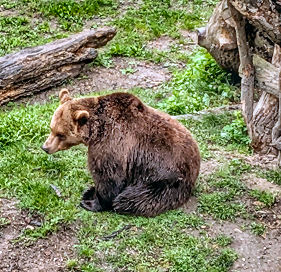 We then had an independent lunch, but all together, as there's not much choice in Torgau on a Monday. I had soup again - lightly-spiced sweet potato this time - with excellent bread, Weissbier and an espresso. After lunch it was back on the coach, for just short of three hours, to the Hotel Elephant in Weimar and a settle into our rooms. Our group dinner tonight was at the 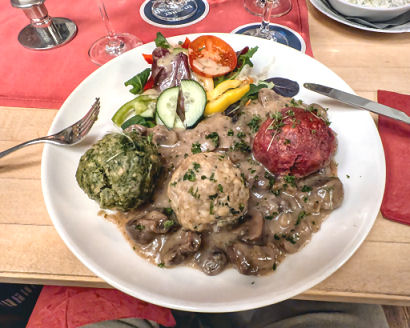 Restaurant Weißer Schwan. Despite the set
menu the veggies could chose from the unusually long list of vegetarian options
on the main menu. And I enjoyed my three different flavoured, and coloured,
dumplings in a mushroom sauce. The salad starter and creme brulee desert were
less of a novelty but good enough. Restaurant Weißer Schwan. Despite the set
menu the veggies could chose from the unusually long list of vegetarian options
on the main menu. And I enjoyed my three different flavoured, and coloured,
dumplings in a mushroom sauce. The salad starter and creme brulee desert were
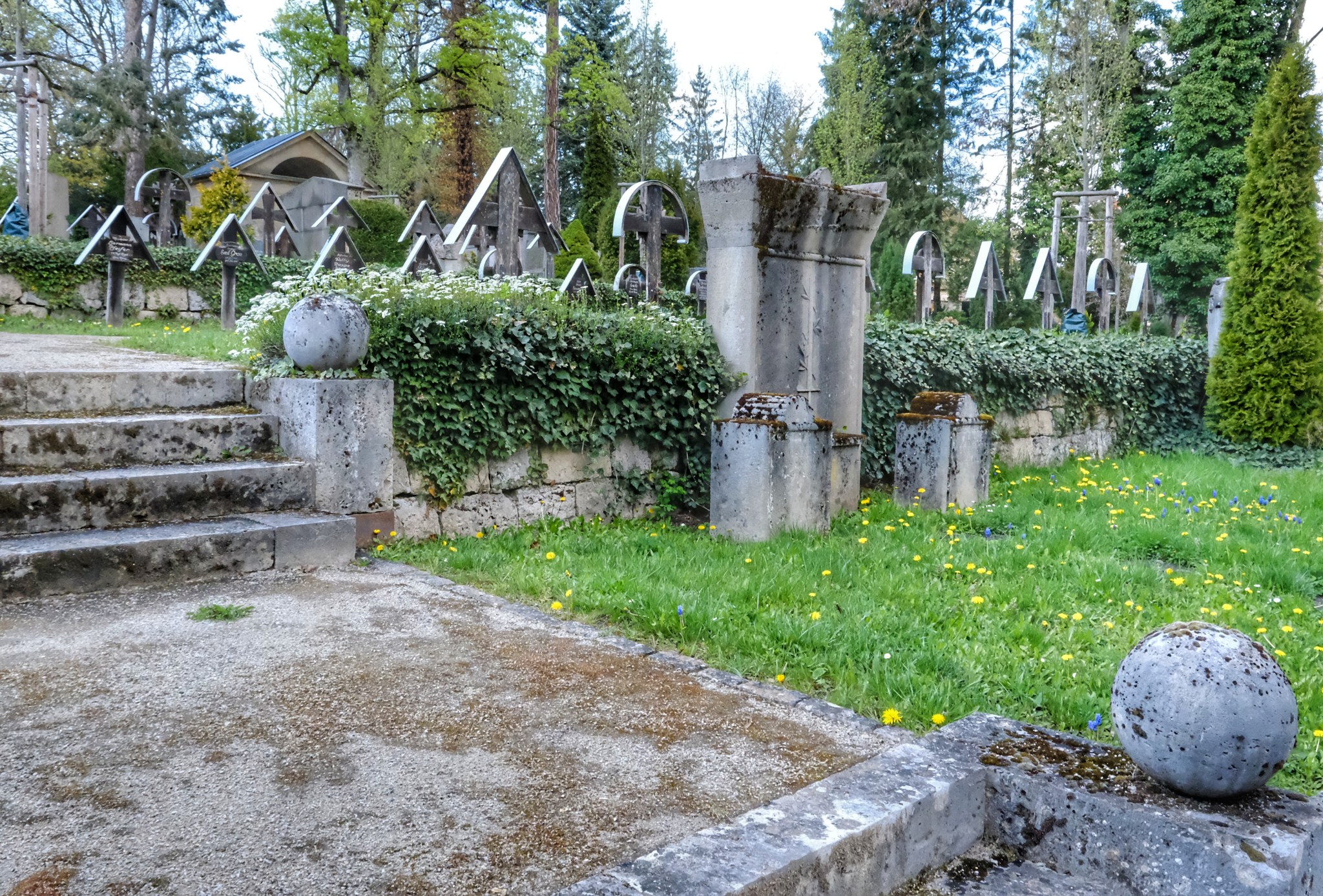
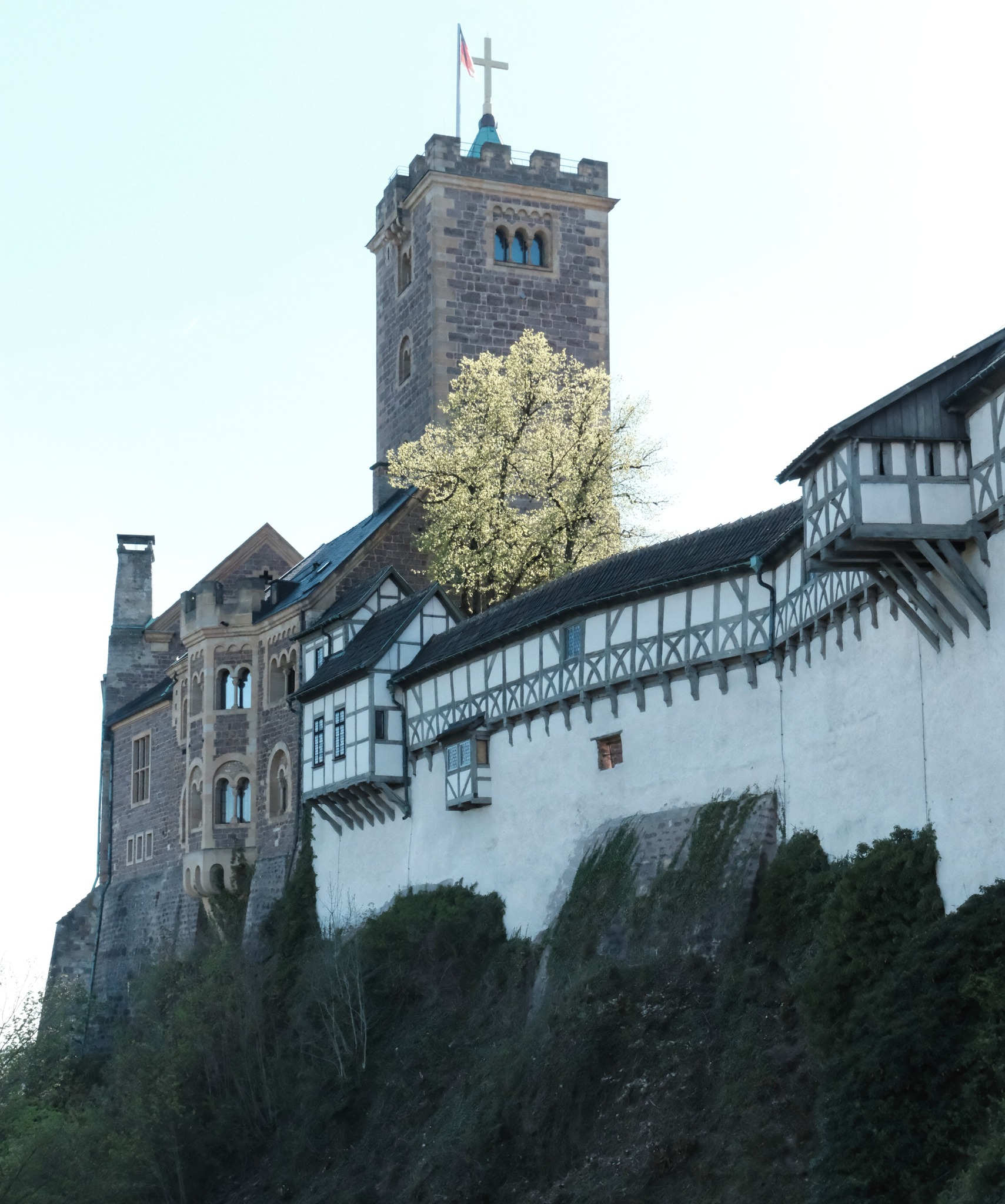
less of a novelty but good enough. Tuesday 21st After our first breakfast in the new hotel - good like the previous one, but still no cake - we took a walk through Weimar’s historic centre, through the Market Square, pausing there to admire the last home of Lucas Cranach, and learn that our hotel was built for Hitler, whose large suite incorporated a balcony to the market square, of course. The room was later used by Thomas Mann, so it’s now named after him. Then on to the church of Saints Peter and Paul, with its spectacular altarpiece by the Cranachs, and more than enough OTT wall memorials. For lunch a few of us walked to a soup place we'd spotted, but it was small and crowded, with a queue, so we ended up at a place called Franz & Willi which had a substantial choice of veggie burgers, mine being the falafel one. Some of us finished lunch early as Stephanie had negotiated tickets to the Anna Amalia Library, which was a gorgeous space and an impromptu treat. To preserve the floor you have to shuffle around with enormous slippers over your shoes, which must keep the staff entertained. A small exhibition of Cranach paintings in the same building, the Grünes Schloss (Green Palace), was on our agenda, but was not impressive. A early finish allowed me a long visit to the town cemetery. It's big, has a Mausoleum with Goethe and Schiller's tombs (which is closed on Tuesdays) and a multi-level field full of war graves, which are matching plaques on crosses covered by little roofs. There was just a coffee machine in my room, so when I got back to the hotel I asked if I could have a kettle to make my redbush tea. One was brought to my room, but when I tried to use it I discovered the base didn't match the kettle. Trotting back down to reception in my socks I got the promise another one would be brought to my room. Which it was, with apologies. The plug in the wall didn't work, so I plugged it in in the bathroom and all went well. Until I went to collect my tea after it had brewed. It was then I realised that the mug provided didn't have anything as uncool as a handle, and was very hot. I thought I'd be able to carry it wrapped in my flannel, without dropping it onto the tiled floor. I was wrong. Luckily two mugs had been provided and for the second attempt I had the brainwave of putting the mug in a water glass, which worked. Wednesday 22nd The first of two days exploring Thuringia, beginning with a coach to Gotha. We're here for the ducal art museum, for the room of Protestant art, with a good few good Cranachs and the Gothaer Tafelaltar, consisting of 160 panel paintings on many flaps, depicting the life of Christ according to Luther’s 1522 translation of the Bible, with the texts included on most panels. We got to roam the other rooms before we left and, for me, experience the thrill of an unseen Casper David Friedrich painting. We then walked over the road and through the grounds of the Schloss Friedenstein as our restaurant booked for lunch is within the palace buildings. It's called the Restaurant Pagenhaus and I had dumplings with a mushroom sauce again and German semolina for desert. The central place-mat on each table was a piece of rabbit fur. Gross, but luckily I didn't notice it until we were leaving. After lunch the coach took us to Eisenach to scramble around the Wartburg Castle. Martin Luther went to school in Eisenach and returned here to lie low in the castle where he translated the New Testament from the original Greek into German. It also has some colourful rooms done out in the 19th century in a German Romanesque version of the 19th-century style that in the UK we'd call Gothick. For our independent evening meal we most of us took ourselves to a nearby Italian called Versilia. It's named after a trendy and beachy part of NW Tuscany. I had a Bufalina pizza and (a first) a Lemoncello with soda. Thursday 23rd For our last full day it was off after breakfast by coach into Thuringia again, to Erfurt, a very preserved medieval town. The buildings may be restored but there's a lot of what we'd call half-timbering, and a lot of charm. We climbed the many stairs up to the cathedral with its impressive ensemble of the Cathedral of St Mary and the church of St Severus. The Cathedral contains a Romanesque stone altarpiece, a huge wall painting of St Christopher, a spectacular floor-to-ceiling font-cover structure, some fine medieval stained glass and two altarpieces worth the visit. One is gold-ground and anonymous and features a unicorn. The other is an unusually Catholic Cranach. There's also a cringe-making Baroque high altar. Then to the Merchant’s Bridge, which is lined with shops so you wouldn't know you were on a bridge as you walk along it. For our independent lunch I went walking and had my first proper gelato of the year, from Goldhelm, a place at the end of said bridge - vanilla with streaks of raspberry and rhubarb (Bullerbűh) and rice pudding with apple and cinnamon (Grandma Ulla's dessert). It was mighty fine. My wander also involved some picturesque spots, some ducks and buying three varieties of spicy redbush tea. Then we met back up by the Cathedral to have a look in the adjacent church of Saint Severus, which had had a memorial service on this morning. We appreciated the sarcophagus of the saint, which he shares with his wife and daughter. The original lid with its three standing figures is now over the Saint Severus Altar. 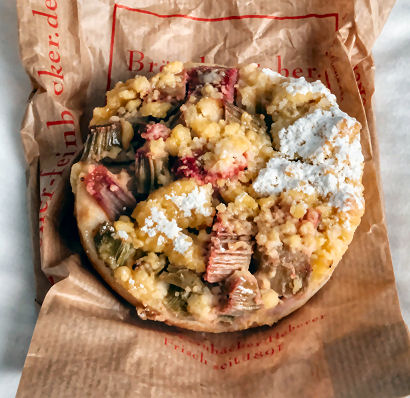 Then we headed back to Weimar and some free time. I had a rest, some redbush tea and a rhubarb tart - my first cake of the week! Our farewell dinner this evening was at Restaurant Bettina Von Arnim. The pea soup had little falafels in it, the main course was a salad of mango, (hold the) avocado, edamame beans, rice, peas bean sprouts etc. For once I liked the dessert the least - a small round dark cheesecakey thing with berries and a blob of ice cream. Friday 24th April In a country of cake-free breakfasts I settled this week into a post-muesli slice of nice bread with jam and a slice of fruit bread. After my last such breakfast we checked out of our hotel and headed to Schmalkalden by coach and to Wilhelmsburg Palace, to admire the Renaissance architecture and decoration of the historic State Rooms. This decoration is to be called mannerist, but is basically grotesque-style with knobs on. The Palace Chapel is an early example of how Protestantism changed things. Then we walked into the centre of town for an independent lunch. I had my final tomato soup, my last Weissbier, and helped my neighbour with her chips. Our coach then took us to Frankfurt airport for our return flight to London. We had to do the finger prints and eye-scan thing at a machine. And then queue at some desks to, in some case, have the finger prints and eyeballs thing done again. Me I just had to wait for my guard to adjust her chair, stare at my passport and/or a screen for a bit, and then stamp my passport. All else went smooth and to time. I learnt a lot this trip, what with my ignorance of Cranach and Luther’s lives. German geography and history too. I also learnt that German hotel breakfasts don’t feature toasters because they see toasting fresh bread as sacrilege – it’s just something you do with stale bread. |
|
|