Non-fiction
Artists
|
Giovanni Bellini |
Lives of Giovanni Bellini
Edited and introduced by Davide
Gasparotto 2018
This palm-sized book might
be mistaken for a gift book, or stocking-filler, but it's much
more substantial and readable than that. It collects the entries
by Vasari and Ridolfi in each's books of artist's lives, one
written decades after Bellini's death; the other more than a
century later, and very reliant on Vasari, even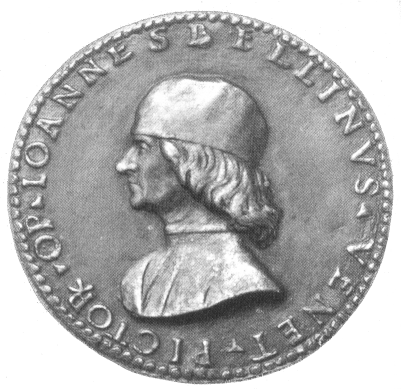 duplicating some
of his errors. There is also Boschini's verse homage to Bellini,
mostly dealing with the San Giobbe altarpiece, and the famous
correspondence between Isabella d'Este and her representatives
and Bellini himself. These latter letters are often mentioned
but it's entertaining to read them, and track Isabella's
mounting impatience with Bellini ever producing the painting
she's paid a deposit for. Eventually he agrees to paint a
Nativity, but then she says she wants it to include John
the Baptist! And at one point she excuses herself from providing
the measurements for the space a painting is to fill by saying
she couldn't stay in Mantua long enough to measure up because
the plague had broken out. Good excuse! The Vasari and Boschini
excerpts are the meat of the book, though, made even more
valuable by the notes detailing errors and the present
whereabouts of works mentioned. An essential little treat for
Venetian art buffs and Bellini fans. duplicating some
of his errors. There is also Boschini's verse homage to Bellini,
mostly dealing with the San Giobbe altarpiece, and the famous
correspondence between Isabella d'Este and her representatives
and Bellini himself. These latter letters are often mentioned
but it's entertaining to read them, and track Isabella's
mounting impatience with Bellini ever producing the painting
she's paid a deposit for. Eventually he agrees to paint a
Nativity, but then she says she wants it to include John
the Baptist! And at one point she excuses herself from providing
the measurements for the space a painting is to fill by saying
she couldn't stay in Mantua long enough to measure up because
the plague had broken out. Good excuse! The Vasari and Boschini
excerpts are the meat of the book, though, made even more
valuable by the notes detailing errors and the present
whereabouts of works mentioned. An essential little treat for
Venetian art buffs and Bellini fans.
Johannes Grave
Giovanni Bellini: The Art of
Contemplation 2018
In vast contrast to the above, this one
is a challenge to the muscles in the average lap - it's huge. This is good for
nice big illustrations and telling details, but not so good for
reading comfortably. So I haven't yet, but when I do you'll be
the first to know. The book's angle is the appreciation of how
Bellini's works are all about contemplation and meditation,
rather than excitement and narrative. As someone who has spent
untold time doing just that in San Zaccaria and the Frari, I
find this perspective compelling, and always have. |
|
Daniel Wallace Maze
Young Bellini
2021
Bellini's parentage and date of birth
have long been sources of disagreement and conjecture amongst
scholars. The author of this book attempts to settle the issue
by gobsmackingly asserting that Giovanni is Jacopo's half-brother,
not his son. That Jacopo was much older than Giovanni is used to
explain their being viewed and described as father and son,
because Jacopo was like a father to his younger brother.
Accepting this allows Giovanni's birth to be earlier and his
career to shift forward enough years to ascribe various
unsophisticated studio-of-Jacopo works to him (and the
illustrations in the Life and Passion of St. Maurice,
previously given to Jacopo or Mantegna, see below) and to
give him the advantage in the arguments about which way the
inspiration flowed between him and Mantegna, his brother in law.
These major shifts
in scholarship are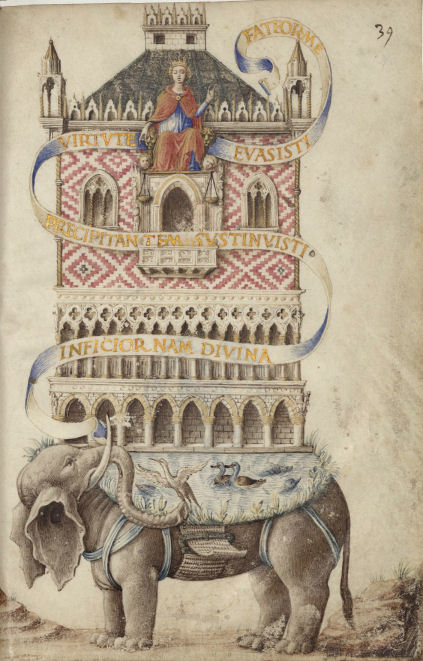 not unusual, but this is the first one to so seismically shift
our understanding since I've been studying closely enough to be
knocked sideways. It's certainly not a theory to be dismissed
easily, and may gain traction. Meanwhile this is a readable and attractive book,
well-illustrated and clearly argued. I liked the observations of the
influence of Altichiero upon young Bellini, as he's another
favourite of mine, but could have done without the
typically-American need for every artist and work to be described
with a superlative. The story ends just as Giovanni gets good,
because at that stage the author's theories become less
important. The book has two appendices setting out his
discoveries and assertions, one of which is the debunking of the
old assertion that there must have been another member of the
family also called Giovanni. He admits that Bellini scholarship
has hardly taken his theory to their bosoms, but that claims
this book tightens up the argument somewhat. We shall
see.
not unusual, but this is the first one to so seismically shift
our understanding since I've been studying closely enough to be
knocked sideways. It's certainly not a theory to be dismissed
easily, and may gain traction. Meanwhile this is a readable and attractive book,
well-illustrated and clearly argued. I liked the observations of the
influence of Altichiero upon young Bellini, as he's another
favourite of mine, but could have done without the
typically-American need for every artist and work to be described
with a superlative. The story ends just as Giovanni gets good,
because at that stage the author's theories become less
important. The book has two appendices setting out his
discoveries and assertions, one of which is the debunking of the
old assertion that there must have been another member of the
family also called Giovanni. He admits that Bellini scholarship
has hardly taken his theory to their bosoms, but that claims
this book tightens up the argument somewhat. We shall
see.
|
|
Carpaccio |
Jan
Morris Ciao,
Carpaccio!
This small book has the appearance of a 'gift
book'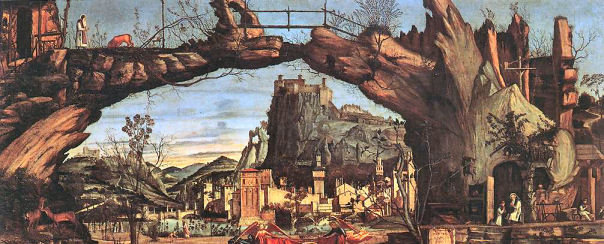 and was published just before Christmas 2014. But to put it in this
category (and hence by the lavatory) is unfair. It is dominated by
illustrations, true, and the text isn't exactly one of art-historical
rigour, but it is a book which definitely Carpaccio fans and probably Venice-o-philes
will want to own and read. The author admits to not being an art historian
and her approach is to react, as a clued-up person admittedly, to the
paintings' content and imagery directly, with no agenda beyond enjoyment. This would usually be a part of a fuller appreciation of an
artist's work, influences and technique but it also works on it's own,
providing insights and pointers to bits you might have missed and generally
freshening up your view of a painter who can come across as a little dry,
and overshadowed by the likes of Titian and Giorgione, but doesn't here. In an overlap with the book above animals and birds do
dominate, as I suppose they must for the painter of a famous winged lion and
many famous dogs and horses, but there's also an interesting chapter where
the Life of the Virgin sequence that he never actually painted but
here is
created from the paintings of her life which he did separately. His careful
and authentic representations of boats get a later chapter, as does his fanciful
yet convincing architecture, which is fruitful as it reflects the mix of fantasy
and reality that characterises his work. The illustrations, especially of
details, are carefully chosen and positioned so that references in the text can
be inspected without explicit directions or page-flipping. Nifty. Which all goes
to make this little book a rather necessary purchase. and was published just before Christmas 2014. But to put it in this
category (and hence by the lavatory) is unfair. It is dominated by
illustrations, true, and the text isn't exactly one of art-historical
rigour, but it is a book which definitely Carpaccio fans and probably Venice-o-philes
will want to own and read. The author admits to not being an art historian
and her approach is to react, as a clued-up person admittedly, to the
paintings' content and imagery directly, with no agenda beyond enjoyment. This would usually be a part of a fuller appreciation of an
artist's work, influences and technique but it also works on it's own,
providing insights and pointers to bits you might have missed and generally
freshening up your view of a painter who can come across as a little dry,
and overshadowed by the likes of Titian and Giorgione, but doesn't here. In an overlap with the book above animals and birds do
dominate, as I suppose they must for the painter of a famous winged lion and
many famous dogs and horses, but there's also an interesting chapter where
the Life of the Virgin sequence that he never actually painted but
here is
created from the paintings of her life which he did separately. His careful
and authentic representations of boats get a later chapter, as does his fanciful
yet convincing architecture, which is fruitful as it reflects the mix of fantasy
and reality that characterises his work. The illustrations, especially of
details, are carefully chosen and positioned so that references in the text can
be inspected without explicit directions or page-flipping. Nifty. Which all goes
to make this little book a rather necessary purchase.
Carpaccio in
Venice: a guide edited by Gabriele Matino and Patricia
Fortuni Brown 2020
As the big Carpaccio show
in the Doge's Palace has been postponed from 2020 to 2023 and
Peter Humfrey's new book about the artist with it, this book
will have to do for a while, scholarship-updating wise. And it
does a good job. It provided a fair few revisions of entries on
Churches of Venice, mostly for the scuole, often with
regard to changes in attribution, mostly after restoration work.
Needless to say the expensive restoration work has resulted in a
solid upgrade in all cases. The book has lots of nice photos,
and details, needless to say, and a stylish layout. Having the
sites arranged by sestiere seems logical but results in, for
example, the scuola building dedicated to Saint Ursula and
the art from it in separate chapters and 40 pages apart. But I
nitpick - this is as good as it gets in helping you find
Carpaccio's works and traces in Venice, and telling you all
about what you're looking at. Save Venice was involved in the
publication so you have to put up with the bigging-up of their
restoration work and the listing of the rich Americans who
provided the funds, and to whom the phrase 'no, I prefer to
remain anonymous' does not come, naturally. Is it a tax thing?
|
|
Giorgione |
|
Enrico Maria Dal
Pozzolo Giorgione
Attentive readers of my sites
might be surprised by how few books about artists there are hereabouts.
It's not that I don't buy them, it's just that most are bought for the
illustrations and usually have disappointing text, often losing fatally
much in the translation. But here we have a lush and lovely book with
fascinating and elegant text, and so I thought I'd share. The language
sometimes slips into eccentricity, it must be said, with the frequent use
of the word 'terse' to describe landscape a noticeable oddity. This is not
the first time I've noted this word used wrongly/oddly in books translated
from the Italian. Maybe it's a mistranslation of a word that might more
comprehensibly be rendered as 'stark' say, or 'sparse'. There is
laughably little known about Giorgione, and the author fesses up to this
hindrance from the off, with a chapter dealing with the certainties. One painting is signed (but on a slip of paper
stuck to the back) and the artist's contested payment for his (largely
lost) work on the frescoes on the outside of the Fondaco dei Tedeschi is
documented. Apart from the notes of a connoisseur who visited palazzi in
the 16th Century and Vasari, with whom pinches of salt ever need to be
taken, that's all the documentation. The action of reading between lines
and following trails is the fascination here, and the book spins
convincing conclusions whilst avoiding tempting wild assumptions. The
second chapter, on the art world and wider society while Giorgione lived and
traded, is enlightening too. Then we get to the third part, and the meat of
the book - each of Giorgione's works, the contested and the confirmed,
dealt with in fine detail and many fine illustrations. The first work is an
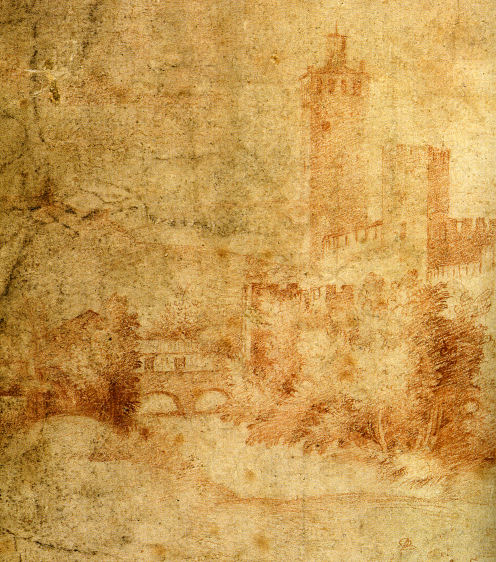
impressively enigmatic work in the Tempest vein which I had not seen
before, Pozzolo calls it Saturn Exiled. Looking to the caption I see it belongs to the National Gallery in
London! Now the rooms of the NG are as familiar to me as the rooms
in my own house, but it seems this lovely puzzling painting is rarely
displayed, its showing dependant on whether current art-historical opinion
is ascribing it to Giorgione or not. Shame.
Update: The painting, which the NG calls Homage
to a Poet by a 'follower of Giorgione' is in Room A, down in
the basement, which is open Wednesday afternoons only, 2.00-5.30. I went on a Wednesday afternoon to check it out and, well, it's
a sweet painting and in a good state of preservation, but if
that's a Giorgione then I'm a gelato. The faces look all wrong. Room A is
a big scruffy hangar, but there's some interesting stuff. Mostly 'attrib's
and 'follower of's, but some surprises, including a Carpaccio in a very
poor
state.
|
|
|
|
Tintoretto |
|
 |
|
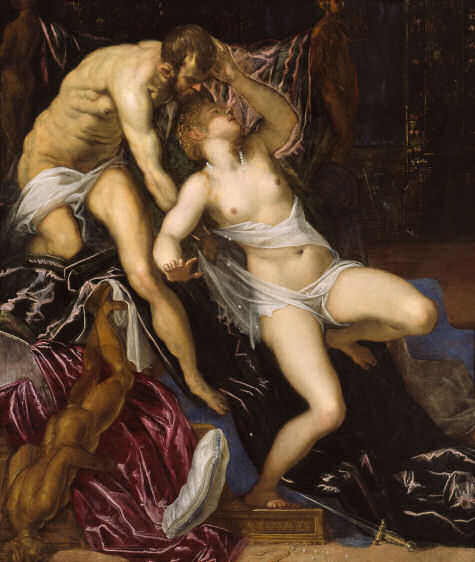
Lives of Tintoretto
(Partly) translated and edited by Carlo Corsato
Like the Lives of
Bellini and Veronese in the same series, also reviewed around here, this book is
more comprehensive, enlightening and entertaining than you might expect from
something so small. (Insert jokes about my, and indeed Tintoretto's, physical
stature.) The quality of the illustrations is again high, in every way, but it
is thicker than the other two. After Corsato's helpful intro there's Vasari
first, of course, and he's dismissive, of course, as Tintoretto isn't a
Florentine, accusing him of being slapdash and rushing his work. But here
Vasari's shortcomings are also pointed out by El Greco, courtesy of annotations
he added to his own copy of Vasari's Lives. We then get brief chapters with
letters to Tintoretto. Firstly from Pietro Aretino, thanking the artist
fulsomely for the paintings on his ceiling.
Andrea Calmo, an actor and playwright who helped
Tintoretto to many early commissions, including Aretino's, is even more florid
in his praise, describing him as a peppercorn and kinsman of the Muses who
'should be glad that, young as you are, you have been endowed with great verve,
a light beard, a profound intellect, a small body but great spirit'.
Veronica Franco uses more sober language, but is obviously very smitten with her
portrait. But the meat of this book - around three quarters of it - is the 1648
Life by Carlo Ridolfi. |
|
The Tintoretto 2019
500th birthday book and exhibition glut
As an admirer but not a lover I didn't indulge
much, but the From Titian to Rubens exhibition was visited,
and the two catalogues and two books were bought. They all relate to
the content needs of
The Churches of Venice, you see,
and mostly have a strongly Venetian air of deception about them.
|
From Titian to Rubens
- Masterpieces from Flemish Collections MUVE
The exhibition, at the Doge's Palace, explored the connections
between Venice and Antwerp around the time of Rubens. The connections
varied in weakness - the Rubens works had little connection to Venice and
the highlight Titian was unconnected to Antwerp, for instance. But the
exhibition undoubtedly had its fascinations. The draw for me, though, was
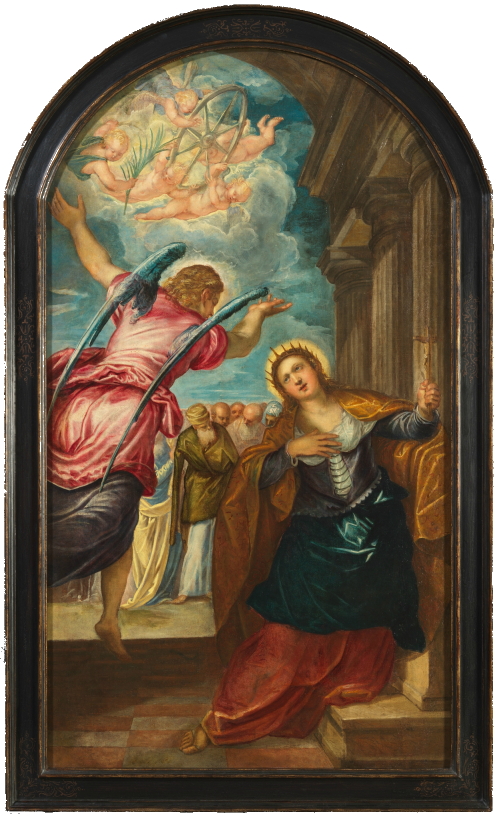
the Tintoretto from the demolished church of San Geminiano, bought by
David Bowie and sold at his death to a private
collector who's now given it to the Rubens House in
Antwerp, from where it's to be on
long term loan here. But this book, as well
 as
the catalogue-content proper, has
essays on art in Antwerp, the use of Venetian
glass
in Flemish still-life paintings,
harpsichords
and books, but nothing about the Tintoretto. For that you needed to buy... as
the catalogue-content proper, has
essays on art in Antwerp, the use of Venetian
glass
in Flemish still-life paintings,
harpsichords
and books, but nothing about the Tintoretto. For that you needed to buy...
David Bowie's Tintoretto: The
lost Church of San Geminiano MUVE
Published to coincide with the 2019 exhibition From Titian
to Rubens - Masterpieces from Flemish Collections in the Doge's
Palace, this is a revised and redesigned version of a book about the
painting published by Colnaghi in 2017. The crowd-pleasing title is
somewhat deceptive. There is an essay on the church, but it also contains
longer pieces on the painting itself, its restoration, and on the
connections between Venice and Flemish artists, like Rubens, van Dyke and
Maerten de Vos - subjects germane to the exhibition but not really
suggested by the book's title. A short piece recalls relevant bits of
David Bowie interviews. This variety means that it serves more as the
second volume of the exhibition's catalogue than a book about Tintoretto
or the church.
|
|
Floriano Boaga
Discovering Tintoretto in the Venetian Churches Editoriale Programma 2018
Well here's an odd one. It's colourful, glossy and inexpensive but, despite the
title, it's actually a book of walks in Venice, arranged by sestiere,
with a short paragraph or two about a particular church beginning each walk. The
Tintoretto works in that church get usefully illustrated with a photo and a
paragraph, admittedly, so it's more a book of walks than art history, also
taking in the churches that don't contain works by Tintoretto. Still, a handy
little bargain, and the occasional translation glitches are all part of the fun! As
are the sarky mentions of Napoleon - never by name, and with ironic quotes
around words like
great
and liberator.Looking at Tintoretto with John
Ruskin
Compiled and edited by Emma Sdengo
Marsilio/Scuola Grande di San Rocco 2018
A book of John Ruskin's writings about Tintoretto, this one is arranged
alphabetically by building - churches mostly. San Rocco dominates, which is fair
enough as the book is published by them, and the first third of the book is an
essay on Ruskin and San Rocco by the compiler. The alphabetical-ordering is a bit
cranky - Moisè, Church of St is followed by Orto, Church of Santa
Maria dell' for example. Handsomely produced, with copious illustrations and
useful plans, this does its job well for fans of the painter and the writer.
 |
|
Titian |
Sheila Hale
Titian: his Life and the Golden Age of Venice
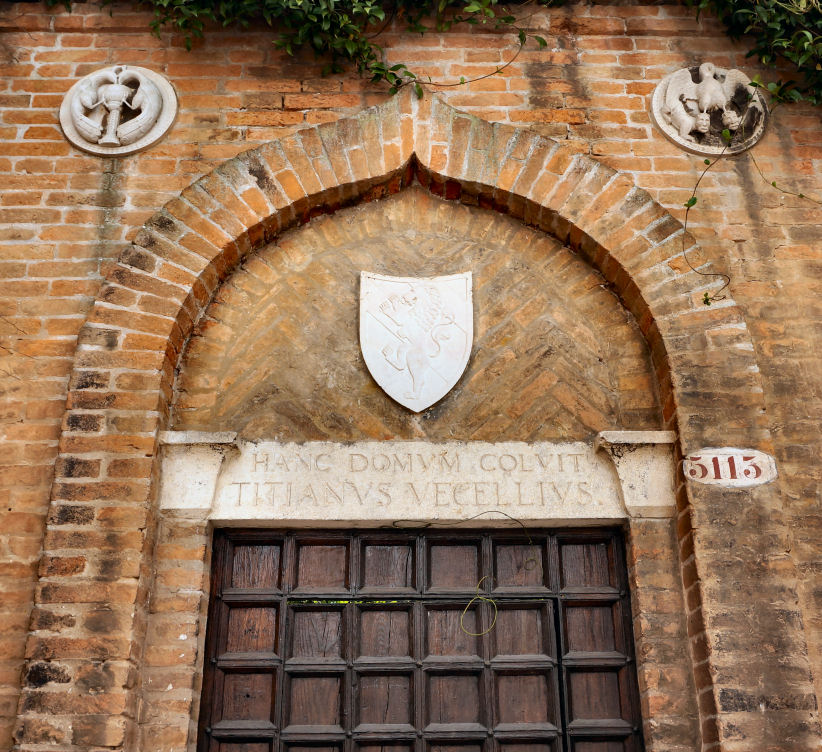
That this book should deal so well with
Titian's career makes it worth your attention, that it also
investigates life and politics and art in Venice as he arrives
and progresses makes it essential. The author initially paints a
vivid picture of the Venice Titian discovered when he arrived
and doesn't scrimp, for example, on giving us the full
background on his first tutors, the Zuccato and Bellini studios.
Later on important friends, patrons and events get discussed
very fully, much more than matters like Titian's technique of
development as an artist, and I for one learnt lots. My
favourite expansion was with regard to the Pesaro Altarpiece in
the Frari church, which I knew had been commissioned by
Jacopo Pesaro,
whose nose had been put out of joint by a hated cousin's
commissioning of Bellini's altarpiece in the same church. But
here I learned that the Pesaro Altarpiece had been commissioned
by Jacopo to commemorate an obscure naval victory - Santa Maura
- during which he had fought for Pope Alexander VI, not Venice,
and months later Santa Maura had been given back to the Turks
anyway as part of a peace settlement. Those few who might've
remembered the battle by the time the altarpiece was installed
would have seen cousin Benedetto, the one who'd commissioned the
wonderful Bellini triptych, as the hero of Santa Maura. It's a
considerable weight of book in paperback, so I decided to go the
e-book route. You thereby lose out on the easy contemplation of
maps and Titian's family tree and the interspersed batches of
colour reproductions of the major works, but on balance these
were sacrifices I was willing to make for ease of reading. And
an easy read it is, and a book which, when you finish it, you
fell you've really read something, and something more than just
an artist's biography.
 |
|
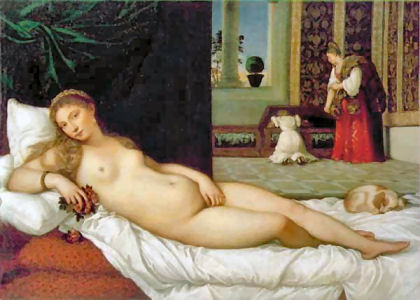
Mark Hudson
Titian: The Last Days
Setting out initially to see if he can find traces of Titian's
famously shadowy last canvases, the author also writes about the
artist's life and development. He does this through devoting
chapters to Titian's teachers and pupils and colleagues and
through some present-day travelogue and interviews. The modern
stuff varies from the pointless to the fascinating. Amongst the
latter is a chapter on the Venetian art dealer who's façade as a
dealer in pretty - mostly 18th Century- stuff for tourists masks
his real interest in buying real art by the like of Tintoretto
and Titian, preferably before anyone else notices it quality and
provenance. The tone of the book is winningly, if sometimes
overly, cynical, but informed and discerning. The author's
contempt for art historians is refreshing, if a little splenetic
and his approach is often nicely non-standard. I'm not sure
you'll find another book about Titian where there's so much
conjecture as to whether he shagged his models, for example. An
easy, breezy read that combines well with your dryer (and better
illustrated) books on Titian.
Paolo Veronese |
Diana Gisolfi
Paolo Veronese and the Practice of Painting in Late
Renaissance Venice
Books about Paolo Veronese are not getting
frequently written, and books which begin by devoting a solid
two chapters to his influences and colleagues during his early
years in Verona are even more rare. So that's me won over.
Adding to the positive is the fact that his career and works in
Venice are copiously compared to those of his competitors and
collaborators there, especially Titian and Tintoretto, but also
the latter's sons and Palma Giovane. On the negative side is the
concentration on technique and materials. This aspect adds
texture, for me, but I can have enough of it, and I'll admit to
skipping the paragraphs which list pigments. And the discussions
of how each image was transferred from drawings, and the
discovery of the traces and indentations that tell us so
much...well it's good to have the benefit of new technical
analysis, I admit, but sometimes not exactly exciting. The
catalogue of the 2014 Veronese exhibition at the National
Gallery in London is probably the best recently-published
introduction, and this 2017 book brings matters nicely up to
date and covers the, sometimes unusual, topics I mentioned.
There, you're all grown-ups, I think that you can now decide if
you need this one.
Claudia Caramanna et al
Paintings from Murano by Paolo Veronese
Also in 2017 there was the exhibition at the Accademia of two
paintings that Veronese made for a church on Murano, for which
this book is the catalogue. Well, calling it a catalogue is
maybe an exaggeration. It's smaller than its price might make
you expect, in every dimension, and contains six essays of
various lengths, some two pages long, the longest one twelve.
There are also twelve pages of congratulatory forewords by the
gallery boss, the cultural director of the Venice Curia, the
heads of three charities involved, and the CEO of the sponsors.
It's a shame we didn't get to hear what the manager of the firm
hired to do the catering at the press launch had to say. Add to
this the frequent copy errors in the text and you might think
that this will be a hard book to recommend. Well it does
concentrate on the much-needed restoration, if that's an area of
interest for you, and the essay on the history, commissioning
and movement of the panels is more detailed than anything I've
read elsewhere. (They were painted for
Santa Maria degli Angeli
but ended up in
San Pietro Martire.) But I think that this is a book for
only the most committed of Veronese fans. Not least because the
paintings themselves are a bit dull, and are likely by his
brother and son. |
|
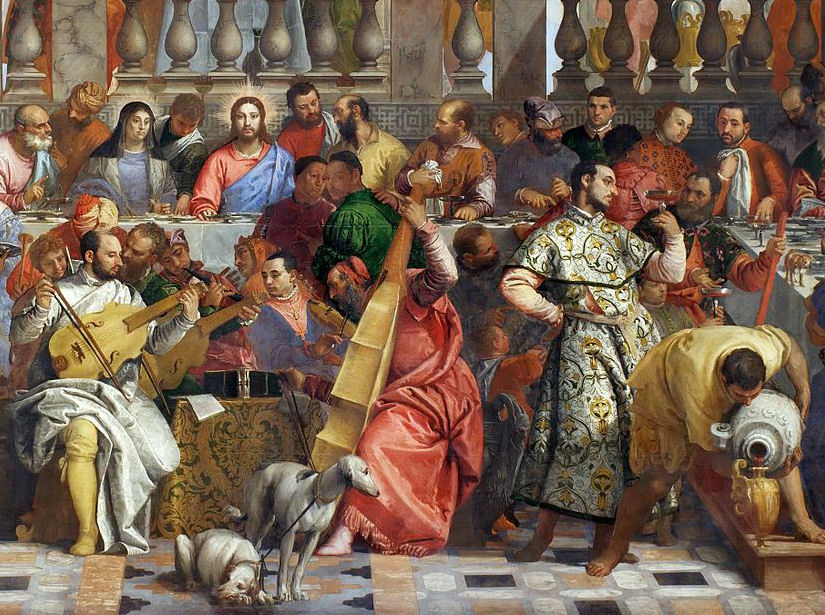
Lives of Veronese
Translated and introduced by
Xavier F. Salomon
Bought in the wake of the
discovery of the Lives of Giovanni Bellini book reviewed
above, this is a similarly academically valuable little book.
Here Vasari's pitifully paltry mentions, found in other artists'
biographies, are followed by an equally sparse entry from
Borghini. These sections each barely stretch to double-figures
of pages, so the 140-odd pages of the biography of the artist by
Carlo Ridolfi are why we're here. It's the first translation
into English of the whole thing and so a very valuable
resource. As it lists and describes Veronese's works
chronologically and in much detail it can sometimes read more
like a resource than a pleasure, in fact - more useful for
reference than for reading. But there's just about enough
digression, poetry and purple prose to keep one reading, with
some judicious skipping advisable when the descriptions get a
bit dutiful. It has judiciously chosen and gorgeous
illustrations too, well positioned near the text, and notes as
to the current whereabouts of the works, like the Bellini book.
The Bellini book is more entertaining and readable, but this
one's useful too. |

History, people and buildings
A 2018 observation - odd how the alphabet
has grouped together, over the years,
four unusually snarky books and/or reviews amongst the first five.
|
Peter
Ackroyd
Venice: Pure City
Coming as is does with an attached TV series, you'd be
forgiven for thinking that Peter Ackroyd is here merely 'doing a Da Mosto'
and starting to read the book does little to stifle these cynical suspicions. Ackroyd's similar, though much larger, book about London is a well-reputed
recent attempt at summing up a whole city, its history, people and
character, using a chronology-mangling and artfully random chapter structure. It
worked for London (although not for me) but here it results in more of the
same for readers of the already very many books about Venice. After a brief intro dealing
with the foundation the chapters do the usual stuff with topics like stone, art,
water, trade, myth-making, sex, hubris and decay. It's
all done very readably, much more readably than usual in Ackroyd's
non-fiction in fact, which often tends towards somewhat self-conscious
flights of style. And if you've never read a history of Venice, or any of
the variously formatted meditations on its unique features (of which a fair
few are reviewed on this page) you might learn much here. A chapter on nature in Venice, its lack and its
incursions, makes fresh reading, but then when talking of the smuggling in
of nature in the grain and fossils within its stones and pillars Ackroyd
fails to mention San Giacomo dell’Orio - a rather glaring oversight, this
church being fossil-flecked-column central. Maybe his research assistants,
credited prominently in the acknowledgements along with only his editors,
didn't venture that far out. He quotes from two sources new to me, aside
from the usuals like Sanudo and
Coryate. One of these is one James Howell,
who has the same surname as my Mum, so maybe I'd better get family-tree
checking. The book's central thesis is that Venice is a prison and that
Venetians have ever been docile and more inclined to be part of a larger
whole than individuals. This allows him then to posit the convents and the
Ghetto as Venices in miniature. I'm not entirely convinced myself. A readable
400 pages, I suppose, but disappointingly unspecial.
|
|
 |
Louis Begley & Anka Muhlstein
Venice for Lovers
A bit of a librarianly quandary with this one.
It is made up of three parts - one short story, one piece of travel writing
and one piece of lit-crit. So, should it go with the fiction or here? Well
I've gone with the librarians who catalogued the copy I've just read. Mr
Begley wrote Mistler's Exit - a novel I
didn't like, and here he turns in a short story again full of the self-love
and admiration for rich people that turned me off then. But these themes take a back seat here to
some pretty overt wish-fulfilment erotica. The primary early lust-object is
again a college-days sweetheart, who spurns our hero, despite the influence
of Venice, and later becomes more than a bit of tart. Lovely. The second
part, by Begley's wife, is about the restaurants that the couple have become
recognised regulars at. It's more about people than food, and is the best
part of this book. In the third piece Begley looks at how great authors have
used Venice, with lots of big quotes and plot spoilers. His examples are
Henry James, Marcel Proust, Thomas Mann and, of course, himself. My case rests.
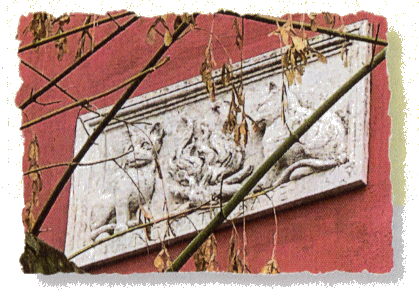
Anna Bellani The Venetian Safari
I must begin by telling you that I am not a
child, and as such I am not the intended audience for this book. It consists
of four walks in search of sculpted animals - one walk each for the sestiere
of Castello, San Marco and Cannaregio and a fourth taking in the other
three, called De Là de L'Acqua ('across the water', as the Venetians have
it). The walks are in large print with nice big photos, but small amounts of
background knowledge. There's no explanation of why a house might have a
giant bee on it, or why a pair of turban-wearing brothers are there but, as
I say, I am a grown-up and like to learn stuff. For a small child following
and finding this is an ideal first step, and should help make fascinating a
city which is not the most child-friendly. And I confess that I am tempted
to do the walks as the animals carved and photographed do look worth
finding, especially the pair of cats in Dorsoduro (see photo above)
although visiting when the trees have no leaves is advised for this one.
 |
|
John Berendt
City of Falling Angels
When this was published in 2005 reviewers tended to
dismiss it as muck-racking and gossipy froth. The book mostly concerns
itself with the devastating fire at the Fenice opera house, and the
subsequent investigation and typical Italian flurries of accusation and
innuendo. The other major strand concerns Jane Turner Rylands, who Bernedt
accuses of being a scheming necrophile in general, and an embezzler of
Olga Rudge in particular. The controversy over Rylands attempting to get the Ezra
Pound letters and papers out of Rudge, Pound's mistress,
for a song is explored in much detail. Rylands (the wife of the director of the Guggenheim) subsequently exacted
some small revenge when she published her second book of Venice-set short
stories, called Across the Bridge of Sighs.
One of the stories
features an unscrupulous American journalist called Cad Peacock who gets
his eye spat in, and the stories evidently contain more thinly-veiled
unfavourable portraits of people who condemned her over the Pound
business. Aside from these two attention grabbers there are portraits of
people - important and eccentric - who live, move, and shake in Venice
today and, I think, it provides a useful update to all the books about
Venice as it was. When I read about and admire, say, Palazzo Barbaro I
sometimes wonder how it's surviving into our Century, and this book tells
you. You'll also learn about pigeons, rats, Woody Allen and the wear and
tear caused by film crews in fragile palazzos. I'll admit, though, that when
I got to the bit about the restoration of the Miracoli church and the
bickerings within Save Venice I started to more fully appreciate the
criticisms that, in the face of the beauty of Venice, to
concentrate on
the festerings underneath is a perverse choice. I skipped much of this
section as it was contributing very little to both my understanding of
Venice and my will to live. A mostly very readable book about
Venice for our times, then, with all the benefits and disappointments that
that implies.
Bidisha
Venetian Masters Under the skin of the City of Love
OK, the problems first. Number one: what's with her not having a
surname? She's not Kylie, or Prince. Secondly, why is the cover so bad? A
drawing of generic, but not authentic, Venetian-type domes. Getting beyond
these minor trials one is immersed in the life of a young woman who decides to go
and live in Venice for a few months in 2004. She has a rich friend, who has very rich
parents who live in a Grand Canal-side palazzo. She meets people, makes
friends, eats
meals and ice cream, and learns about the locals. She writes well and
sharply about the people, and makes a very good go at the city itself and
its buildings. (I'd never thought that the Frari church looked like Bourbon
biscuits myself, but I'll have a compare next time I'm there.) There's very
little actual art appreciation as such, which makes the title a bit
confusing. (She also makes the daft mistake of mixing up the (small)
Bellini altarpiece in the Frari with the (huge) Titian one.) Maybe it's to
do with getting a symbolic masters degree in being Venetian? Dunno. The fact of our observer being more at home in
bars and social gatherings, rather than art galleries and churches, is
sometimes over-apparent - this is a book more full of evenings than
daytimes. And the unrestrained pointedness of her evaluations of a lot
of the people she meets makes you wonder at their reactions, and the warmth
of her welcome back. She is also refreshingly unflinching in her portrayal
of the misogyny and prejudice she encounters. This all gets more than a
little out of hand, though, in the final section - a later visit for the
Biennale - where her feminist rhetoric, hyper-sensitivity to perceived
slights and bitchiness towards her friend's mother begins to leave
a bad taste in the mouth. She has a rant about the only famous Venetian
women being 'colourful poetry-spouting hookers' and the like, and how women
artists were 'locked out'. She thereby fails to give any credit to Marietta
Tintoretto and Rosalba Carriera, two admittedly rare exceptions, but no less
worthy of mention and praise for that. If you can get beyond the
bile, the book can be a perceptive and flavoursome
Venice fix from a different perspective than usual. Or it might just make
you flinch too much for real enjoyment.
|
|
Giacomo
Casanova
History of my life
translated
by Willard R. Trask
Johns Hopkins 1966-71
He's Venice's most famous son, and
one of those rare people whose name has entered the language - everyone
knows what he liked doing, and so anyone with an enthusiastic but light-hearted attitude
to love is likely to get called a Casanova. This is not entirely
unfair, but it's also not the whole story. He saw himself as a man who
loved well and often, rather than one who trifled with women, and it's a view you
can have some sympathy with. He writes so well, feelingly, and
perceptively about society in 18th century Europe that you can't help
admiring him. His story starts with his childhood in Venice and he returns
home at intervals from
his travels around Italy and Europe. And his adventures are sufficiently varied
and spicy to hold your attention like a good novel of the period would.
This translation, published in paperback in six handsome double volumes, was
the first untamed edition.
|
|
 |
|
|
Thomas Coryate
Most Glorious & Peerless Venice
(edited by David Whittaker)
If you've read much about Venice's later history then Coryate's name
will have arisen. His 1608 book Coryate's Crudities is frequently
mentioned as a primary source on life (specifically the experiences of a
visitor) in Venice in the 17th century. But how many of us have read the
book itself? Not me, I admit. So, praise be to David Whitaker who has
collected the Venetian section of the Crudities into one
handsome paperback and in the process made the language more comprehensible,
without losing its quirk and charm, I think. It's not the most concise and useful of
guides, but it has flavour and eccentricity to make amends. This is not a
book to read to learn, as such, but I did learn that the classic six-pronged
gondola prow didn't appear until around 1630; and that Colleoni, of the
equestrian statue, was so called because he had three testicles, coglioni
being Italian slang for a testicle. There's also a discussion of why
there were no horses in Venice, which has been a contentious topic in a
couple of conversations I've had with Venice buffs, it having been argued
that there were, which is madness. And Coryate loves his numbers, boy does he
love his numbers! If you've ever wondered how many paces it takes to cross
Piazza San Marco, or how many steps are on the Rialto Bridge, then Coryate
is your man. Another eccentricity is how, even when visiting the Scuola di
San Rocco, he never mentions the names of artists. He rhapsodises about the
music he hears here too, but similarly doesn't mention any composers.
Although he does tell us that the musicians who performed in the Scuola were
paid a hundred ducats, which he tells us is equivalent twenty-three pounds
six shillings and eight pence. He also experiences a Greek Orthodox service in San Giorgio and
discusses the Jewish religion. He seems to find Jews to be strangely like
other human beings, but still thinks that their religion is an abomination.
Courtesans and the divers varieties of melons on sale get a fair amount of
coverage too, the former with unconvincing apologies and disapproval, the
latter with warnings of
the danger of death if you eat too many. All good eccentric stuff, and
genuinely and fragrantly evocative of its time. |
|
Giorgio & Maurizio Crovato
The Abandoned Islands of the Venetian Lagoon
(Le isole abbandonate della laguna veneziana)
This book was originally published in 1978
by two journalist brothers who were shocked and ashamed at the
way the history and treasures of the Venetian lagoon islands had
been ignored and plundered for so long. The original book, which
followed an exhibition, documents the islands' sad decline and
dilapidated state. This updated edition provides some cause for
optimism that the situation has changed much in the intervening
years. The brothers undoubtedly did good, though, raising
awareness and also reawakening interest in the use of
traditional rowing skills, which had been long in decline and
are now again flourishing, what with all the anti-motorboat
feeling and the increasing knowledge of the damage they do. The
new edition of the book (which has Italian/English dual text)
has an updating introduction by the brothers and then a chapter each on thirteen of the islands, consisting of
historical texts describing the island in its glory days, then
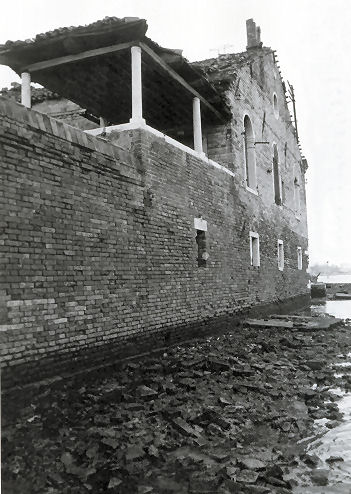
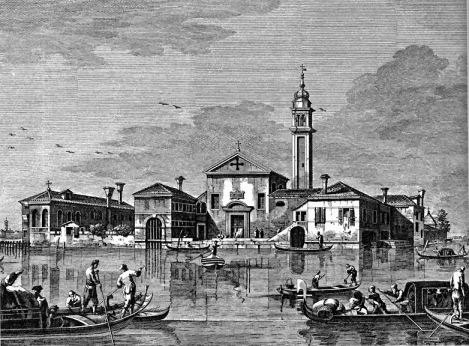
some lovely old prints made back in them days (there's one
below) and photos of
their sad 70s state (that's one on the right). These black and white photographs
(which are also the work of the brothers) are a
major part of the pleasure of this book, at least for this fan
of romantic ruin and crumble. The future is looking less bleak
for some of the islands as they are being preserved and converted to uses
ranging from luxury hotels to a
museum of lagoon history and facilities for various educational
institutions. All these efforts deserve our support and 10% of
sales of this book in the UK will go to Venice in Peril, and 10%
of US proceeds will go to Save Venice. So the least that you can do
is buy and enjoy this book. You can get it from the publishers
sanmarcopress.com,
some shops in London, most of the bookshops in Venice and many online sources. |
|
|
|
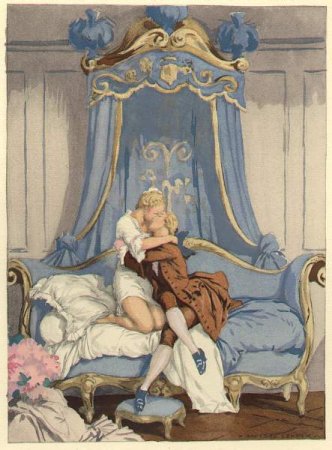
 |
|
Andrea di Robilant
A Venetian affair
In the attic of the family's palazzo in Venice the author's father finds a box
of letters made into damp wads by time and humidity. These turn out to be
further evidence of the torrid relationship between Andrea Memmo, an ancestor,
and a half-English woman called Giustiniana Wynne. Using these and other letters
Andrea di Robilant pieces together a story of brazen love, and romance thwarted,
in 18th century Venice. The story of the affair is interesting enough, but the
book also evokes the era well - the time of Venice's fading as a real power and evolving
into a magnet for visitors. Hitherto Venice would be known more for its visitors
than its natives (see John Julius Norwich's Paradise of Cities - reviewed
below) and so it's appropriate that Consul Smith and
Casanova play their parts here, as an early influential foreigner and the last
famous native respectively. The love story evolves at a stately pace but has
just enough events and details, sometimes lovely sordid ones, to keep you
reading. Just as mobile phones are essential to the development of any affair
nowadays, so masks where a big help back then. As Giustiniana is banished back
to England, via Paris, so the tale takes on a sadder note as the making of
choices and the wasting of lives becomes the theme, and our heroine evolves
into a far stronger and more ambiguous character. The emotions are well
observed and identified by the author, who fills in gaps in a convincing
way, and so you end up with a strong feeling of real lives.
This Earthly Globe - a
Venetian Geographer and the Quest to Map the World
The author is on more serious ground here, and covers
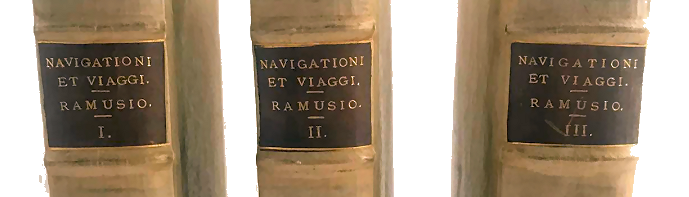
more ground, like The Whole World! The book is about Giovambattista Ramusio
who worked for the Venetian government during the time when the world was
becoming a much bigger place, but knowledge was guarded by the countries
doing the discovering. Ramusio travelled a bit but also gathered a lot of
the reports and diaries of others, a task made easier by his diplomatic
connections. His collection resulted in Navigationi et Viaggi, a
multi-volume book, published in 1550-59, and invaluable ever since. These
reports take up most of the book, and are fascinating, so this is not so
much a book about Venice. But there is a goodly amount of writing about
famed printer Aldus Manutius, a constant colleague of Ramusio, so the
Venetian flavour remains strong. |
| |
|
 |
Iain Fenlon Piazza San Marco
If, like me, you look upon the Piazza San Marco
as a crowd-infested nuisance to be passed through as quickly as possible
then you, like me, may be in need of something to reawaken your fascination
for what is arguably Venice's most important space. This book could be that
something. The writing is much more elegant than we have any right to
expect, the stories are well told, and the scepticism at the more
far-fetched of these tales is refreshing. After a very interest-stirring
introduction the chapters begin with the myths and early history of the
Piazza and Venice. The fascinating conjecture here for me was how, having
been founded well after the Roman Empire, Venice lacked the status that such
ancient history conferred, and so the mythologically loaded story of St Mark
and his vision, and his remains being brought to Venice, conferred some much
needed theological clout and state-cred. We're then taken through the
history of the piazza up until the present (tourist-infested) day. The
chapters are themed with, for example, a chapter on the processions and
rituals (including fascinating details of the doges' funerals) which is followed
by one devoted to the traders, performers and scammers who have always been
a fixture. Everything from the most important political events to ritual pig
disembowelments and a Pink Floyd concert have happened here, with the
performance of rituals and music and problems with traders and
visitors being pretty much constant themes down the centuries. The last
chapter ends with the observation that the problems facing Venice today are
to be seen concentrated into the Piazza, with its shuffling hoards just
happy to be there, to say they've been to Venice, and with little
experienced beyond the café bands, the buzz and the pigeons. Which neatly
loops us back to the start of this review.
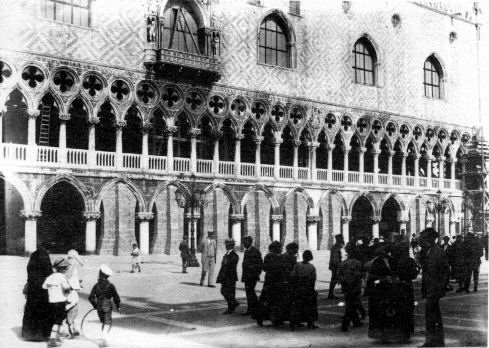
The photo below (from the book above) shows the Doge's
Palace in 1915, with brick supports under the arches and protective
scaffolding around the sculpture of Adam & Eve on the corner in case of
bombing.
 |
|
|
Giulia Foscari Elements of Venice
If I tell you that this book was written to accompany
Elements of Architecture, an exhibition developed as part of the 2014
Venice Architecture Biennale you, like me, might expect an insubstantial and
hastily-created book heavy on concept and light on content. How wrong we'd
both be. Firstly I need to warn you that to pick up this paperback is to
have to have it. It's a gorgeous little brick of a book, full of photos,
plans, charts, graphs, drawings and isometric views to excite us fans of
architecture and cityscapes. Each of
the book's chapters concentrates on an element of
Venice's architectural fabric. The one devoted to façades is a bit of a
catch-all but later ones about, for example, staircases and fireplaces
are fascinatingly confined. It seems that the book was created in
haste to catch the exhibition, but you wouldn't know it - there is much
knowledge being imparted and many fresh facts to pick up. There are pages
devoted to why, and how, the churches are orientated the way they are, and
to Napoleon's impact on the fabric of the city. There's a list of Venice's
major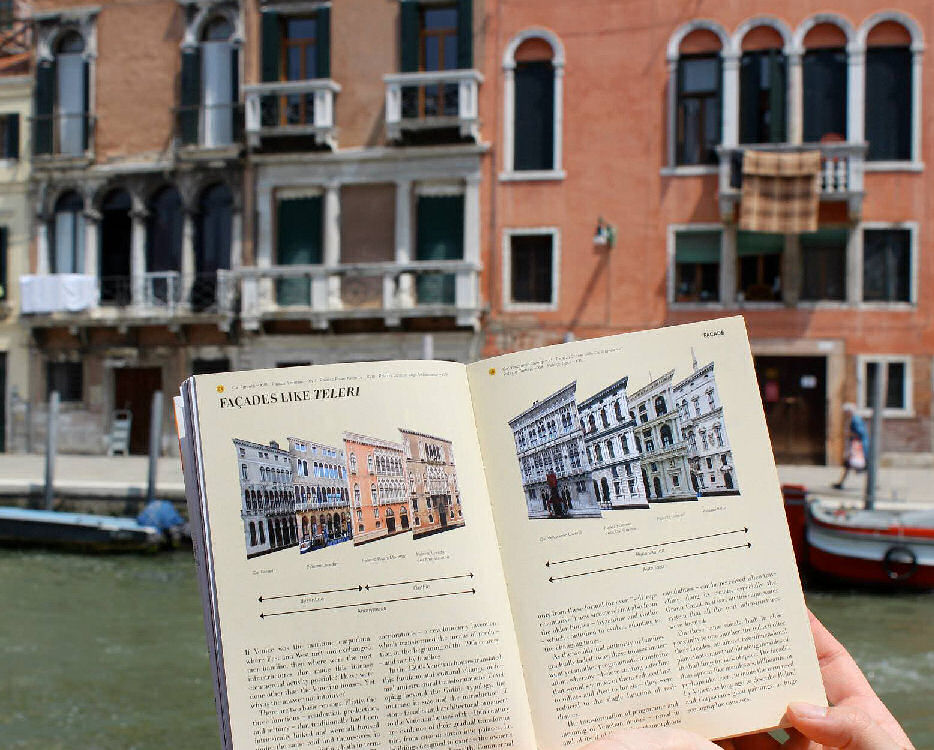 destructive fires down the centuries and an analysis of the ways, and
directions, in which Venetian houses were added to. The damages wrought by
tourism crop up unsurprisingly often. destructive fires down the centuries and an analysis of the ways, and
directions, in which Venetian houses were added to. The damages wrought by
tourism crop up unsurprisingly often.
The language can descend into arcane
architectural-theoretical gobbledygook, but it does this surprisingly
rarely, and more in the accompanying quotes than in the text. I hope that
I'm giving you an impression of a desirable thing to grace your bedside
table, for picking up when you need a fix of what you love looking at in
Venice, with the good chance you'll learn something too, or at least get a
different slant on something you may have taken for granted.
Robert L France
Veniceland Atlantis
The bleak future of the World's
favourite city
To attempt a comprehensive and comprehensible
review of the social and environmental catastrophes facing
Venice would be enough of a challenge, one would think. To do so
whilst also weaving the city's cultural and fictional fabric
through the facts and figures would seem to be both admirably
and foolishly ambitious. But in this book Robert France pulls
this off, and elegantly with it. The facts and futures are
presented in a winningly understandable and untechnical way,
guaranteed to enlighten and depress in equal measure. Things
really aren't looking good for Venice, and the way that this
fact plays up to the city's image as a place of post-hubris
decline and slow death is covered here too. The book manages to
be true to
the facts and the spirit of Venice, is what I'm trying to say. Being an optimistic sort of guy I tend to try to
block out a lot of the issues dealt with in this book, but to do
so is to live in a fantasy world, which is also somewhat
appropriate. (As the creator of this site I stand accused of
this and confess freely.) The scary facts are presented in a
serious, but not despairing way. Rising water levels, erosion
caused by speeding boats, pollution, pigeons, overvisiting,
governmental apathy and lassitude - this is stuff all serious
Venetophiles need to know about and this book is a one-stop
source for getting up to speed on the problems and possible
solutions. Some of the facts, especially in the section on the
tourist hoards forcing out the locals, will make most jaws drop.
Three quarters of all visitors are day-trippers, the tourism
levels (proportion of tourists to residents) are nine times
higher than Florence, the cruise ships can contain the
equivalent of fifty tour buses each and bring ten percent of all
tourist revenue. And most amazingly - sixty percent of all
cruise ship passengers don't get off the boat! Another
weird one: tourists are responsible for thirty-five percent of
all economic activity, but make eighty-three percent of the
waste. There
was once a website too which, amongst other things,
had colour versions of the black and white photos in the book,
but it seems to be no more. I
don't know if the decision to go with monochrome in the book was
made freely or forced by financial considerations but it doesn't
detract and chimes well with the book's serious,
non-coffee-table, nature. A new necessary purchase for all good
Venice bookshelves.
Martin Gayford
Venice: City of Pictures
Reading the title you're entitled to wonder if
his is a book of pictures painted in Venice or pictures painted
of Venice. And the answer is it's both - Venetians up to Tiepolo
and visitors from then on. It tells stories you may have read
before but mixes them up appealingly. So the often-told tale of
Bellini meeting Durer, as reported in the latter's letters,
is mixed in with both their dealings with Isabella D'Este and
Giorgione's life and fresco decoration of the Fondaco dei
Tedeschi. The author is famous for his books about David Hockney,
who gets more than his fair share of gratuitous mentions as this
book begins. But then we settle in to the Bellini family,
Titian, Tintoretto, Veronese's trials over his Last Super,
Tintoretto and his daughter - the classic story with
fashionable additions. It's an easy read with just enough
detours from the usual and fresh focuses to keep us veterans
interested.
|
|
Marie-Jose Gransard
Venice: A Literary Guide for Travellers
Literary Companions to Venice - books of
collections of writings from the big and famous names - are not rare, but this isn't quite one of those. Under various
nebulous chapter headings - 'Faith Art and Politics', 'Lust and Love', 'Death and Mystery' - the author details the reactions of visitors to
Venice. and the rhapsodies of some locals. All the usuals get their
stories aired - Henry James, the Ruskins, Byron, Casanova, d'Annunzio, for
examples - plus a few less common names, like Turgenev, Chekhov and Oscar
Wilde. Authors who've set stories in Venice get dealt
with too, and film-makers too, in a book that doesn't plough a narrow furrow. It's all here, but
you might already know much of it, if you've been paying attention to this
site. Such swathes of people and works are covered, though, that you can't
help but make discoveries.
Vaughan Hart and Peter
Hicks Sansovino's Venice
Like
Sanudo's Diaries and
Coryate's Crudities
Francesco Sansovino's Guidebook to Venice of 1561 is a book more
read about than read. The author was the son of the famed Venetian
architect and sculptor Jacopo, who was still alive when the book
was published, so the guide provides a picture of Renaissance
Venice just as Jacopo's work around Piazza San Marco was
coming to fruition, and before the coming of Palladio. The book
takes the form of a conversation between a Venetian and
Foreigner, the former walking and talking the latter around the
city, discussing history and customs as well as topography and
art. This literary dialogue form was not unusual in itself, but
it was unprecedented for a guide book. The Foreigner is
basically a straight man reacting, saying complimentary things,
and egging on the Venetian. The introduction gives us
much background and deals much with Francesco's attitude to and
discussions of his father's architecture. This fresh building
work gets discussed much here, which is no surprise as Hart is
primarily an architectural historian - he wrote the books, as it were, on dark-baroque Brit
architectural icons John Vanbrugh and Nicholas Hawksmoor, and with Peter Hicks
he gave us Palladio's Rome. When the guidebook itself gets
going it establishes its eclecticism pretty soon by discussing
customs, costume and prostitution. The blurb says that the book can still
be used as a guidebook, but I'm not sure this would be
practical, as the subject arrangement is eccentric and there is
much hopping around geographically. There is an index of
sorts, at the beginning, and the profusion of illustrations
(mostly modern colour photographs) makes it quite easy to know where to
stop if you're flipping through looking, for example, for
churches. Reading through the pages about churches illustrates
the variable worth of the text - there are occasional quirky
details but mostly you are just told that a particular church,
for example, is 'greatly praised by people' or that some others
'render the city noble and beautiful'. But after the glib
comment 'there are many churches, and all of them highly
esteemed 342', if you consult note 342 at the
end of the book it tells you that for more information you
should go to
churchesofvenice.com. A fresh achievement - I've made it
into the realm of scholarly notes!
Birgit Haustedt
Rilke's Venice
I freely admit to coming to this book with a clean slate, as it were, with regard to Rilke. But as I
start reading I learn that he loved Venice and wrote many poems
about the place. The book consists of eleven walks through parts
of Venice that Rilke knew, loved, wrote about and stayed in. The
book's copious quoting from his writings nicely evokes Venice in
the early part of the 20th Century, a period in the city's
history not much written about. It's not greatly different from
the present day, but there are occasional surprises, like
Rilke's complaint about the eternally noisy children in Campo
San Vio - a place for peaceful contemplation and the consumption
of tasty pizza slices on most of my recent visits. This is not a
book for one-sitting cover-to-cover reading but I'm slowly
working through it for regular Venice fixes, which is a role it
suits. Taking it and using it as a guidebook is, I would
suggest, for real Rilke fans, but reading this could well make
you one. The translation (from the German) is elegant and reads
so well you wouldn't know. Add to this the handsome red cloth
cover, with well-chosen photograph, and you have a tasteful
treat for Venice buffs.
Deborah Howard and Henrietta McBurney
The Image of Venice: Fialetti's View and Sir Henry Wotton
Oduardo Fialetti was an artist from Bologna who came, via
Rome and Padua, to Venice and worked with Tintoretto. These
influences led to his being an artist stronger on disegno
rather than the Venetian colorito and to his more
recent reputation resting on has many prints, rather than
his few paintings, several of which are to be found in Venice's churches. He also painted a
bird's-eye view of Venice which ended up, largely forgotten, at
Eton College, until it was restored a few years ago. This book
begins with essays telling the history of Venice and relating
this history to the production of maps and views, most famously
that of Jacopo de' Barbari, and how these views were produced to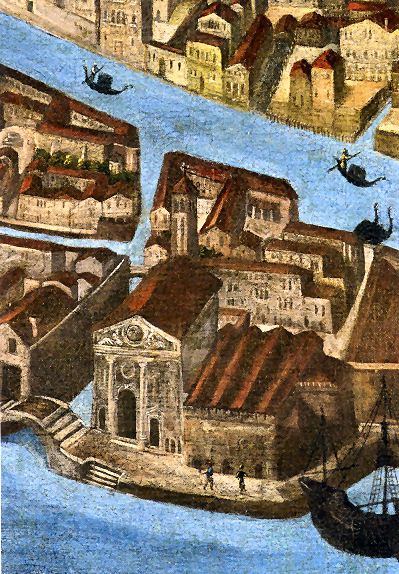 reflect and enhance the myth of Venice, and what they tell us of
the contemporary state of Venice's fortunes. They were not made to help you find your way
around. Other essays tell of the fact of the next 200 years of
maps all deriving from the de'Barbari view, the changes made on
the later maps, and the changes strangely not made. (The
now-demolished church of Santa Maria dell'Umiltà is shown
strangely large (see right) suggesting that the map may
have been made for a Jesuit, the church having been run by the
Jesuits before they were expelled in 1606.) In the absence of a
good recent book on maps of Venice this is all good stuff. There
are eleven essays in all, and in addition they deal in detail
with the restoration and tell of the Wotton, who was British
ambassador to Venice for many years and a provost of Eton, and
of the map's time in Eton.
reflect and enhance the myth of Venice, and what they tell us of
the contemporary state of Venice's fortunes. They were not made to help you find your way
around. Other essays tell of the fact of the next 200 years of
maps all deriving from the de'Barbari view, the changes made on
the later maps, and the changes strangely not made. (The
now-demolished church of Santa Maria dell'Umiltà is shown
strangely large (see right) suggesting that the map may
have been made for a Jesuit, the church having been run by the
Jesuits before they were expelled in 1606.) In the absence of a
good recent book on maps of Venice this is all good stuff. There
are eleven essays in all, and in addition they deal in detail
with the restoration and tell of the Wotton, who was British
ambassador to Venice for many years and a provost of Eton, and
of the map's time in Eton.
|
|
Lucy Hughes-Hallett
The Pike Gabriele d'Annunzio -
Poet, Seducer and preacher of War
Much was made in reviews and interviews with the author when
this biography was published of what a hard-to-love character d'Annunzio
is. He got through lovers like the rest of us get through toothbrushes, he
thought that nothing was more noble than (for other people, and lots of
them) to die for his country and irrigate its soil with a martryr's blood
and remains, and he pretty much prepared the ground - politically and
presentation-wise - for Mussolini to sell his fascism to a
well-prepared Italy, although he was far from a fan himself. Amongst some
other 'although's is the fact that most of his lovers had pretty impressive
personalities, and were mostly older and stronger than him. And he had a
style about him which, although far from making him lovable exactly, makes
his life prime material for a biographer who knows how balance and present.
That LH-H has a fine and sparkling prose style to match her subject makes
for an exceptionally fine read. D'Annunzio never lived anywhere very long,
mostly due to pursuing creditors, but he lived in Venice for
a good while, during most of WW1, in the Cassetta Rosa,
opposite what's now the Guggenheim Museum. There's a fair amount of Venetian
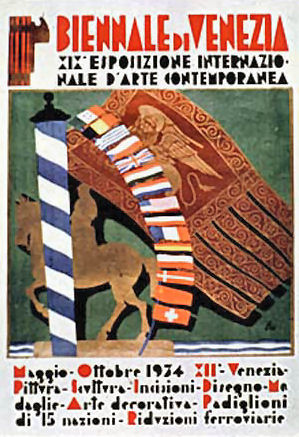
content here, then, including the fact that Hitler and Mussolini first met
in Venice in 1934, and that Hitler was unsurprisingly less than impressed
with the 'degenerate' content of that year's Biennale. D'Annunzio and his
then lover, the actress Eleanora Duse, were also regular strollers in the
Garden of Eden during its Edwardian prime, and the place featured in a
thinly-veiled novel he wrote about their relationship. The
unpaid bills that
his creditors were after him for were mostly for clothing, cleaning, cravats
and flowers. And the decadent plushness and high temperatures of his rooms
is a recurring theme, as is his sweet tooth. In summary - an unflinching but admirably
gripping biography of a man who's hard to admire. But you just might, a bit.
|
Thomas Jonglez and
Paola Zoffoli
Secret Venice
I don't tend to do guidebooks on these pages,
but this one is different. It actually lives up to the title,
even for one such as I who smugly thinks he's surprise proof,
what with making this site and almost a dozen visits. Some of
the secret places and a few weird facts were already known to
me, but I admit that lots weren't. The matching London volume I
was less enlightened by, showing that only by living in a city
can one truly know it. These guides push this point too, by
featuring the by-line Local guides by local people. The
presentation and page layouts are modern, with 'box outs' and
digression sections, but stylish and easy to read - not always
the case when designers try to be different. There are plaques
and carvings here I'd never noticed and buildings and gardens
that can be visited if you know who to ask (and the authors tell
you). Medical oddities, unknown libraries, eccentrics and
artists all feature. And who knew that Venice had two bowling
greens? You'd have to be a Venice resident of some age to not
get something from this book, I think, and I'm getting a lot.
Ian Kelly Casanova
With 2005's film and TV series, and not a few novels published
in recent years, you could hardly describe Casanova as a
forgotten figure. This is, however, the first big biography for
a while, and a more modern evaluation of the man is therefore
not a little overdue. Mr Kelly is no fusty academic, though, and
so this is likely to be seen as an entertainment rather than a
contribution to the scholarship, not that he doesn't do a pretty
thorough job. His main source is Casanova's own History of my
life (reviewed above) but he is at pains to sort the truth from
the myth-making by comparing the memoirs with known dates and
other written sources - he seems to have put in some time in the
Frari state archives. The emphasis is on Casanova as a performer
wherever he went - his theatrical childhood is seen here as the
major influence on his personality. Kelly being an actor himself
(and by some accounts a bit of a performer offstage too) makes
this emphasis understandable and not unconvincing. He gets a bit
carried away with his use of language sometimes, but when he
settles down this is a very readable romp. Kelly is also not
unsympathetic to Casanova's convincing contention that he was a
lover rather than a user of women. A lover-tally comparison
is made with the likes of Byron, and even Boswell, and Casanova
is found not to be the sex-machine that he's often painted.
 |
|
Petr Kral
Loving Venice
This is another of those (usually) slim volumes that try to
define the essence of Venice with expressive flights and encompassing
theories. This one does at least balance the flights with some more grounded
observations of real life - real people and places do appear out of the
philosophic mists, as it were. It was written in 1998 so there are some
dated observations, like the mention of the only open cinema being the one
near the Accademia, for example, and talk of smoking indoors.
Grisaille is not a word one comes across often, but if you
had a pound for every time it's used in this book you'd soon have it's cost
covered. The author was once a Czech surrealist, we're told. Physically the
book is one of the usual lovely things published by Pushkin Press, with a
cover artily cropped from a Sickert. If a book can be said to be rarefied
then this one is, although to use my more usual confectionary-comparison
mode it's more of a soufflé than a bun, let alone a full meal, but the
flavour of Venice is strong.
Clemens F. Kusch & Anabel Gelhaar
Architectural Guide - Venice Buildings and Projects After 1950
Typical - you wait ages for a stylish guide to Venice's architecture from a
fresh and modern perspective and then two come along at once! But whereas
Elements of Venice by Giulia Foscari, reviewed above, takes a new view
of old buildings this one concentrates on more recent constructions. These
range from grand designs like the road bridge, Piazzale Roma, car park, Rio
Nova project to tasteful door cases. One of the two influential figures
presiding over this period is Eugenio Miozzi, a name new to me. His
influence as planning and building director for Venice stretches from 1931
(the Ponte della Libertà road bridge from the mainland was opened by
Mussolini in April 1933) and aside from the Piazzale Roma development just
mentioned included the Scalzi and Accademia bridges and some unrealised but
ambitious road-link projects. This book celebrates his ambition and the
talents of Carlo Scarpa but doesn't shy from some harsh observations and the
criticism of notable failures. The section on the Calatrava Bridge, for
example, is comprehensive to the point of incomprehensibility for the
non-specialist, but also points out the stupidity of the hurriedly added
wheelchair pod, which is badly designed, boils users' brains, and is never
working anyway. Offering free vaporetto trips between the station and the
bus station for wheelchair users would've been a much cheaper and more
elegant solution, as the text points out, admittedly in one of its less
elegantly-translated paragraphs. (The translation can best be described as
readable but eccentric.) The arguments for leaving Venice's fabric
well alone and preserved are aired too, along with the opposing view
revolving around the need to keep the city building-stock fresh and provide
accommodation for the non-mega-rich, thereby keeping the real people in
residence. In between are the adjustments and additions to existing
buildings which you often don't notice. The book is generally an aid to
pointing out the presence of buildings that you might pass by and ignore,
sometimes with good reason it must be confessed. The book is divided into eight colour-coded areas/walks, with maps,
and a ninth devoted to unrealised projects. This last chapter is a more
free-form discussion of famous unrealised projects like Frank Lloyd Wright's
palazzo and the radical hospital designed by Le Corbusier which was never
built, up past San Giobbe. There are lots of apartment blocks around
Venice's edges in here, and modern biennale pavilions. The modern building
we all remember, with a shudder, the bank (Cassa di Risparmio) in Campo
Manin, turns out to have been the work of one Angelo Scattolin, also
responsible for a couple of other sites for sore eyes in Venice. The entry
for the bank ends with the sentence, regarding the placing of a new building
so near the city centre, Not accidentally, it was an experiment
that was hardly to be repeated. So maybe we've that to be grateful for.
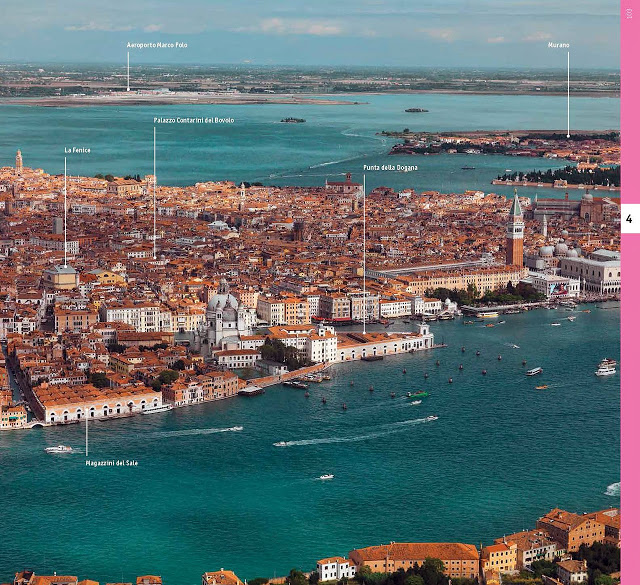
Venice's postwar architecture is a very rarely-covered
subject, which alone makes this book a somewhat essential purchase. Added to this is
it's sharp design and excellent photos, including many gorgeous clear aerial views
(see left) spread across two pages, making it another object of
desire. |
|
Mary Laven Virgins of Venice
This book was published in 2002, and one suspects that the
subsequent
fashion for novels that revolve around Venetian convent life has
been not-a-little inspired by its revelations. It's unflinching
in its detailing of transgressions and punishments and of the power of
economic and political considerations to ruin women's lives.
There's a good deal of friendship and support in evidence, but
the overriding impression is of women locked away - regardless
of their vocation, or lack of it - so as not to be a drain on
their family's financial resources. The convents also reflected
the stratification of the society outside their walls, with
cliques of idle women from the ruling families lording it over
the poor nuns forced into the convents by poverty, and forced to
work. There is a subtext that the convent life may have given
some women more chances to explore their talents and sexuality
than they would have had as wives or spinsters outside, but
incarceration is incarceration. This book sure adds
texture and detail to one's understanding of life behind the
walls, and the shifting nature of secular and religious
attitudes. It's a non-dry
must-read for anyone interested in the convents and the lot of
women in Renaissance Venice.
Mary Lutyens (editor)
Effie in Venice Mrs John Ruskin's letters home, 1849-52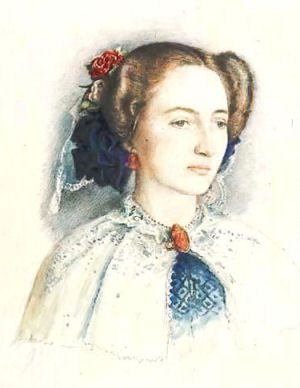
The book opens with an indulgent but evocative,
and short, account of the editor's times in Venice, firstly in
1924 and then after the war in 1946 with her husband Joe Links,
and their later trips. She then gives us the background and
details the development of the relationship between John Ruskin
and Euphemia Gray. This period takes in the continued
non-consummation of their marriage, a situation which was
to continue in Venice. If you know anything about the couple it's
that their marriage failed due to this non-consummation, and
that an annulment was granted, at which point she was still a
virgin. There's been much salacious conjecture as to the reasons
for this. Ruskin himself writes, in a statement later, that
there were 'certain circumstances in her person which completely
checked' his passion. This has been interpreted as meaning many
things, from a repugnance at her pubic hair, which he wasn't
expecting having only ever seen female nude statues and
drawings, to a squeamishness at her menstruating. Far more
likely, given his observable and continued preference for
idealised young girls, he just couldn't take all the
real-life smells and textures of a real grownup woman, and all the
hygienic sacrifices that a physical relationship entails. The letters are
from Venice during the two trips, also taking in the
preparations and journeys. They're concerned mainly with Effie's
social whirl - the parties she goes to, the Austrian soldiers
she meets and the frocks she wears and admires. Equally there's
much about the Ruskin in-laws and their attitude towards her,
which was rarely what one would call supportive. So there's a lot
of reading between the lines to be done regarding the couple's
separate lives in Venice and how much the parents (Effie's also)
contributed to the divisive emotional stew. Without this back-story the
letters make somewhat tedious reading, and even with it I found
myself skipping whole chunks regarding the mixings and cupboard-skeletons of European royalty, and who's
saying what about whom. Some juicy Venetian details, to be sure,
but not enough to make this more than a cautious recommendation
for the general reader. Towards the end there's the excitement
of a robbery and Ruskin challenged to a duel. The book ends with
Effie writing to her mother about a sitting for Millais, the man
with whom she would finally lose her L-plates.
Judith Mackrell The Unfinished
Palazzo
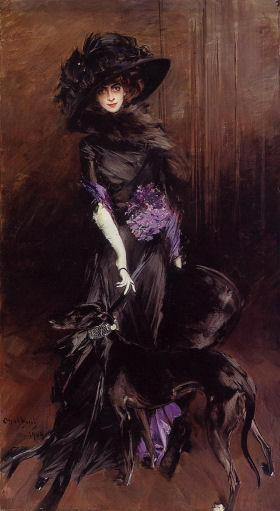 This book recounts the lives of the three women
who stamped their identities upon the eternally-unfinished Palazzo Venier dei Leoni in the 20th century. Identity-stamping amounted
to the life's work of Marchesa Luisa Casati who rented the one-story ruin
to stage wild, gilded and gaudy parties. Her society could be so
described as well - Diaghilev, D'Annunzio, Fortuny
and Giovanni Boldini (who painted the famous portrait of her
right) all have their parts to play in her early
development, with the later lovers and friends so numerous and
famous as to make my revealing them amount to almost a plot
spoiler. Her time in Venice
allows the author to sidetrack into the lives of Venetians
Veronica Franco and Elena Cornaro Piscopia but this is a book
more about frocks and gossip than feminism. And the Marchesa spends
little of her life in Venice. I'd had my fill of her, and her
shallow and spectacular party-centric life, to be honest, quite
a few pages before we moved onto the shorter of the three life
stories. Doris, Viscountess Castlerosse starts life as a girl from Streatham
but using her looks, long legs and bedroom skills on a
succession of rich and titled men, works her way towards one who
might marry her. Her famous friends include Noel Coward, Winston
Churchill, Cecil Beaton and
Beverly Nichols. In a world where women sometimes have to become
prostitutes just to survive the fact that Doris does it for fur
coats and fripperies does little to make you warm to her. (The
UK tabloids have recently got into a froth about her all over
again as she's the actor Cara Delavigne's great aunt.) She eventually
needs to leave London, lest her relationship with Winston
Churchill become better known and hinder his rise, and so she
sails to New York, and there comes over all lesbian. This is
when she acquires The Palazzo Venier, using said lover's money.
(The author never uses the word 'lesbian' for some reason,
always calling such relationships 'Sapphic'.) But Doris just
gets to throw one end-of-season party there before the impending
war means she must leave, never to return. So with maybe a few
weeks spent in Venice in all the years covered by the book so
far, we embark on the second half of the book anticipating that
we and Peggy Guggenheim might now spend more time there, and
maybe concern ourselves with more than parties and sex. But after a brief Venetian frisson as Peggy makes an early
visit and becomes enamoured it's down to the usual round of
dysfunctional relationships, tragic parenting, much sex and much too little
humanity. She acquires the larger part of her collection of
modern art in Paris just before the Nazis march in, so getting
them all for knock-down prices from fleeing dealers and artists.
Her concern for getting these works out before the Nazis arrive
took priority over the more humanitarian concerns that others
laboured for. There is an attempt to make us forgive the woman's
entitled and self-centred insensitivity by blaming it on
insecurity and self-doubt, but I wasn't convinced. Peggy
Guggenheim's declining years at least keep us in Venice for a
while. This book is an easy and gossipy read, full of juicy
details, as is indicated by the length of this review, but the
palazzo here is really just a residence in common rather than any
kind of fruitful subject in itself. Ditto Venice itself, mostly. This book recounts the lives of the three women
who stamped their identities upon the eternally-unfinished Palazzo Venier dei Leoni in the 20th century. Identity-stamping amounted
to the life's work of Marchesa Luisa Casati who rented the one-story ruin
to stage wild, gilded and gaudy parties. Her society could be so
described as well - Diaghilev, D'Annunzio, Fortuny
and Giovanni Boldini (who painted the famous portrait of her
right) all have their parts to play in her early
development, with the later lovers and friends so numerous and
famous as to make my revealing them amount to almost a plot
spoiler. Her time in Venice
allows the author to sidetrack into the lives of Venetians
Veronica Franco and Elena Cornaro Piscopia but this is a book
more about frocks and gossip than feminism. And the Marchesa spends
little of her life in Venice. I'd had my fill of her, and her
shallow and spectacular party-centric life, to be honest, quite
a few pages before we moved onto the shorter of the three life
stories. Doris, Viscountess Castlerosse starts life as a girl from Streatham
but using her looks, long legs and bedroom skills on a
succession of rich and titled men, works her way towards one who
might marry her. Her famous friends include Noel Coward, Winston
Churchill, Cecil Beaton and
Beverly Nichols. In a world where women sometimes have to become
prostitutes just to survive the fact that Doris does it for fur
coats and fripperies does little to make you warm to her. (The
UK tabloids have recently got into a froth about her all over
again as she's the actor Cara Delavigne's great aunt.) She eventually
needs to leave London, lest her relationship with Winston
Churchill become better known and hinder his rise, and so she
sails to New York, and there comes over all lesbian. This is
when she acquires The Palazzo Venier, using said lover's money.
(The author never uses the word 'lesbian' for some reason,
always calling such relationships 'Sapphic'.) But Doris just
gets to throw one end-of-season party there before the impending
war means she must leave, never to return. So with maybe a few
weeks spent in Venice in all the years covered by the book so
far, we embark on the second half of the book anticipating that
we and Peggy Guggenheim might now spend more time there, and
maybe concern ourselves with more than parties and sex. But after a brief Venetian frisson as Peggy makes an early
visit and becomes enamoured it's down to the usual round of
dysfunctional relationships, tragic parenting, much sex and much too little
humanity. She acquires the larger part of her collection of
modern art in Paris just before the Nazis march in, so getting
them all for knock-down prices from fleeing dealers and artists.
Her concern for getting these works out before the Nazis arrive
took priority over the more humanitarian concerns that others
laboured for. There is an attempt to make us forgive the woman's
entitled and self-centred insensitivity by blaming it on
insecurity and self-doubt, but I wasn't convinced. Peggy
Guggenheim's declining years at least keep us in Venice for a
while. This book is an easy and gossipy read, full of juicy
details, as is indicated by the length of this review, but the
palazzo here is really just a residence in common rather than any
kind of fruitful subject in itself. Ditto Venice itself, mostly.
Javier Marías
Venice, an Interior
This is a slim volume - 55 pages of double-spaced
text, written by the renowned Spanish novelist for the newspaper El
País in 1988, and now also published in a collection
of his essays called Between Eternities.
It's less waffley and ephemeral than some such volumes, dealing
with concrete topics like population, geography, walking, and
Consul Smith. He even says original things sometimes, and has
some quite acute observations on personal horizons and mobility.
A small pleasure.
|
Jan Morris
A Venetian Bestiary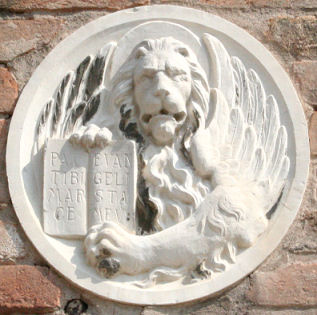
A slim volume dealing with
the creatures
associated with Venice and to be found in its
history and art and on its streets. Birds, sea creatures, cats,
dogs and some more mythical beasts are all to be found in here.
There's the winged lion, the portentous birds, the horses that
were once ridden and the bronze horses that were stolen by and
taken from Venice. There's a chapter on the cats, of course, with a
few famous moggies, including Nini the Frari cat and the
unfortunate sole victim of the San Marco campanile collapse.
This chapter also points out how Venetian artists have all
failed to portray a convincing cat, despite a
fair number of memorable dogs. A small book, then, but one full of tasty nuggets. (I speak of gold, not
chickens.) |
Judith
Martin
No Vulgar Hotel: The Desire and Pursuit of Venice
A book about what it is to be a Venice-lover, written by a
Venice-lover, for other Venice-lovers. What's not to love? Well, a tendency
to tweeness, the coverage of some familiar ground, and a certain lack of
depth. But set against this we have some spot-on analysis of what makes us Venetophiles tick and some undeniably witty writing. She covers topics like
the famous visitors and the hated Napoleon, but also the pitfalls of the
property market and the books and films that we obsessives pore over.
Her precise analysis of the impossible route of Katherine Hepburn's
canal-jumping vaporetto in Summertime will strike a chord in most
of us, I imagine. You'll find yourself grinning often with self-recognition,
and the realisation that you're not the only Venice obsessive to do the
sometimes sad things she describes. She pretty much nails the joy of posing
regally on balconies overlooking the Grand Canal, for example - a pleasure
that pretty much beats sex, I think. It's a cosy read rather than a
challenging one, but a pretty much essential one for all of us members of
its intended readership, no matter what stage of the ongoing relationship
we're at.
Predrag Matvejević The Other Venice
This is the sort of book that has a blurb saying that
it promises to 'utterly reconfigure the Venetian cityscape'. But
don't let that put you off. What it is is a collection of short
chapters each dealing with an odd aspect of Venice's rich and
hidden tapestry. There's a piece about the weeds that grow out
of the cracks in church walls and another about an eccentric old
Venetian who stands in the same sotoportego every day and spouts
fragrant 'facts'. Other topics include Venetian bread,
fragments of pottery emerging from the slime of ages, barbers,
and paving stones. An intriguing and entertaining read but
rather lacking in real substance , I thought. A cake of a book,
rather than a full meal.
|
|
Carlo Moretti
Venice - Her Art Treasures and Historical Associations
This is a guidebook of 1871, available as a facsimile reprint published
by Elibron Classics. It's interesting how early the pattern for guidebooks
to Venice was established. This book, like many that followed, takes up the
first third of its length (following a brief history) with Piazza San Marco
and the Basilica. This is followed by a trip up the Grand Canal which picks
out the important palazzos to left and right but here has no pictures or maps,
presumably relying on the reader's gondolier to name the buildings, if not
to know too much about them. It's also fascinating is how the buildings of the
18th century are here described as being 'in the architectural style of the
fall'.
Hidetoshi
Nishijima Memories of Venice
Well here's a weird one - a book
of photographs, taken by one Fenton Bailey, of a famous Japanese actor taken
as he arrives in Venice, wanders around, and leaves. He's wearing the same
crumpled white linen shirt, black trousers, Doc Martens (no socks) and
sultry/bored expression in every shot. It's like a sequence of (sorry)
typical Japanese tourist shots where the subject must stand in front of
a famous building. Except without the smiles and synchronised jumping. Or the famous buildings,
mostly. He poses on a bridge, he looks at some glass, he walks past a
church, he takes a vaporetto, he slouches in some alleys. But he never
ventures very far from San Marco, judging by the recognisable details. Not unVenetian,
just unexciting. He's wearing the same
crumpled white linen shirt, black trousers, Doc Martens (no socks) and
sultry/bored expression in every shot. It's like a sequence of (sorry)
typical Japanese tourist shots where the subject must stand in front of
a famous building. Except without the smiles and synchronised jumping. Or the famous buildings,
mostly. He poses on a bridge, he looks at some glass, he walks past a
church, he takes a vaporetto, he slouches in some alleys. But he never
ventures very far from San Marco, judging by the recognisable details. Not unVenetian,
just unexciting.
With thanks to Matt D for the finding
and the providing. |
|
|
|
|
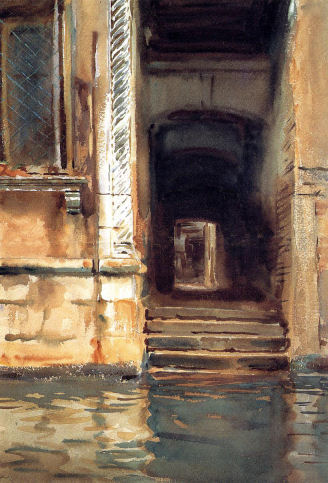 |
|
John
Julius Norwich Paradise of Cities
Venice and its nineteenth-century visitors
This book looks at Venice from the fall of the Republic in
1797 through the nineteenth century - the period during which the city had
to begin to come to terms with its new role as a city defined by its
visitors. It's appropriate, therefore, that it does so through the lives of
famous visitors and foreign lovers.
After a chapter each devoted to the fall and Napoleon, we get straight down
to a quartet of Englishmen, none of whom were exactly paragons of Victorian
wedded stability. Chapters for Byron and Ruskin are followed by a
chapter devoted to two chaps named Brown who kept their dalliances with
handsome gondoliers very secret, for many years, unlike Baron Corvo whose
later indulgence in the same predilection, a little more openly, scandalised
the British ex-pat community. John Julius deals well with
these, more private, aspects of lives whilst also keeping and broadening our
interest with the less racy details and observations.
Later chapters deal with the Siege, Sargent, Whistler, Wagner, Henry James
and Corvo. (Very few plain and domestically-blissful home lives here.) This period chimes nicely with our melancholy and
faded-glory view of Venice and so this is unlikely to be the last book to
deal with this century, but it is the one to beat.
John Julius once answered my prying Venice
Questions. |
|
Sarah Quill
Ruskin's Venice The Stones Revisited
Ruskin's place as the foremost foreign fighter for Venice of
relatively recent times is assured, and The Stones of Venice is the proof that
remains. In its full length it remains pretty daunting for the average reader.
His concentration on surface detail and his prejudiced abhorrence of the
classical can be wearing too. There have been many attempts to abridge - a few
years ago Jan Morris made a pretty good job of it - and there have even been
editions published in the form of guide books. In this, the most recent
abridgement, Sarah Quill presents mouth-watering snippets of Ruskin's prose
arranged in guide-book format by building and all made more gorgeous by lots of
his drawings and her photos.
A less glossy and more portable abridgment of The
Stones... is
available as a Penguin edited by J.G. Links. |
|
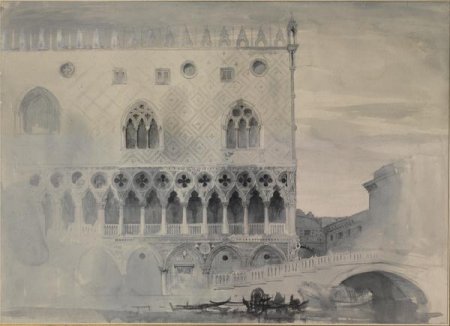 |
|
|
|
Heather Reyes
ed. city-pick Venice
It was inevitable that this series
should get around to Venice, but not that they should get me to write the
introduction for it. They did, and so this book has my name on it. Such
circumstances make a bad review almost impossible, I'll admit, so you'll just
have to trust me when I say that this is one fine collection. Most of the books
on this non-fictional page have excerpts in here, as do a lot of the novels I've
listed and reviewed on the main Venice fiction page. If you're thinking that
this makes for a some major symbiosis (and some other sym-prefixed words) you'd
be darn right. The extracts include fewer writings from the last few decades
than in the previous volumes, but as most of the big names and the best writing
about Venice date from the 19th century (and just before and just after) this
was inevitable. There are still some surprises and gems from late 20th Century,
though, and Heather Reyes works her magic again by making the extracts link and
flow in a way that transforms the book into much more than a mere dipping thing.
What more can I say? If you like the city and this site you'll need this book, and so will
all of your fiends.
Robin Saikia The Venice Lido
A slim volume that is nonetheless fat with
facts about what is an often forgotten part of Venice and which remains a fascinating
anomaly. I admit to seeing it as a place apart myself, as very different from 'my' Venice, of
art, gelato, decay, and dark romance - the Lido being just so 'seaside', so bright and
full of sky. It's acquired a reputation for fun and glamour, what with the film
festival and the beach-front hotels and all, that's not, for me, very Venetian. The
author obviously loves the place, though, and reading his book often made me think I'd
done the Lido wrong. There's lots of history - from Malamocco being the first
centre of Venice, through the famous old wedding-with-the-sea ceremony to visits from Mussolini and
Hitler. The concentration, though, given the reputation for glamour and
indulgence, is unsurprisingly on the late 19th century and, especially, the
early decades of the 20th. Diaghilev, Cole Porter, Churchill, Thomas Mann
and the Mosleys all feature amongst the period wastrels. I
think that the aspect of the Lido that I can get behind, and which this book
brings out, is its status as a break from the rigors of Venice itself. There's
more nature and sky to be found here and a visit can be a rest from the crowds
and the crumble. But however you approach it this book will broaden your
horizons.
Click on the link to read Robin's answers to
The Venice Questions.
Cynthia
Saltzman
Napoleon’s Plunder and the Theft of Veronese’s Feast
A subject much touched on over on
The Churches of Venice,
but not until 2021 did a book come along and add this much to our knowledge and
understanding of Napoleon's flagrant looting of Italy's art collections and churches.
Stronger on the history than the art, but with plenty of detail on the personalities
and politicking and attitudes that lead to, and tried to prevent, the plunder
and the damage suffered. The history bias means that there's lots of detail on
the arguments for restitution after the fall of Napoleon, and who made them, but
less on the reasons for choosing the places the pictures where returned to - a
subject I find interesting, and often puzzling. The detailed reports of how
these works were removed and treated will leave you shaken, I warn you. I didn't
realise that the Bellini altarpiece in San Zaccaria had to be removed by
knocking down an area of the wall of the church behind its stone framing and
dragging the panel through it. All but one of the 16 pictures on the French
commissioners' original list of the works to be looted were encased in their
original architectural frames in fact. Of the eighteen pictures the French
stole from Venice fifteen were returned.
Patricia H. Labalme, Laura S. White,
and Linda L. Carroll
Venice, Cità Excelentissima
Selections from the Renaissance Diaries of Marin Sanudo
Marin Sanudo's diary, kept from 1496 to 1533, consists of 58
volumes, now kept in the State Archives. It's 40,000 pages contain an
unparalleled record of life in renaissance Venice. Official documents, private
letters, news from abroad, first-hand records of events...all were copied, and
sometimes pasted, into the diaries. Initially he planned that the diaries would
form the source material for a history of Venice. This was never written, but
his awareness of the future publication of the material kept him from being
too critical of the Republic. As a source of details of everyday life in Venice
during this period, though, the diaries are unsurpassed. They've long been
milked by authors and scholars as a primary source, but here we get the first
user-friendly volume giving us access to the cow itself, if you'll pardon my
metaphor. The expertly-selected excerpts are collected into chapters on a
variety of subjects covering the arts, religion, society and politics. This last
topic dominates as Sanudo was involved, through his holding of various posts,
with the governance of Venice throughout the whole period, a time of much
turmoil and event.
Tiziano Scarpa
Venice is a fish A cultural guide
An attention-grabbing title, you have to admit. But
this book is not about Venice from a surrealist perspective - it's another
of those collections of rambling and entertaining (usually)
digressions on what makes Venice Venice, with the promise of secrets
revealed and essences distilled. After the explanation of the fish theory
there are small chapters called things like feet, legs, heart and
face, dealing with the joys of wandering and getting lost, the
gondolier's stance, Venice as a city for lovers, masks and the need for them in
such a small city, and so on. All very entertaining and even occasionally
educational, but
then my cool
appreciation got very much heated up by the smell and sight
chapters. The first is full of fragrant poo and pee lore, including an
explanation of the Venetian proverb In the Summer even turds float, and
the latter has cat stories and reveals the secrets of the differences between,
and conventions in naming, calli, salizada, rami, rii and the rest. It
also posits the theory that Venice is such an eye-bashing feast that it needs
view-blocking scaffolding and eyesores like the bank in Campo Manin just to give
our eyes a rest.
|
|
Toni
Sepeda Brunetti's
Venice
This
is a handy-looking little book, nicely presented and with good
maps. It takes the form of twelve walks through Brunetti's life
as presented by the novels, with much use made of lengthy quotes,
which points up Donna Leon's obvious sanction of the project.
Toni Sepeda, who gives Brunetti tours, obviously knows her stuff
and needs us to know it. After a while the waffley and
self-important tone began to grate on me, I must admit. I'd
suggest the book's use to help find locations rather than as a
cover-to-cover read or as a guide to take on your travels. The
novels are anyway usually topographically followable, and
winningly rare in their lack of invented locations
and other such liberty-taking.
Serge Simonart Venezia
This books is pretty, but also pretty annoying. It's mostly old photos and
postcards, with some ephemera - book covers and pages mostly. There are also a
few essays on stock Venetian subjects like hotels, love, courtesans, and the
carnival. The fact that the book is not large means that the photos are either
portrait-format on single pages or landscape and spread across two pages and
down the gutter, which is a minor annoyance. The major annoyance is that only
about thirty of the images get captions, in a double-page spread of
postage-stamp-sized images at the end - no page numbers or index either. Old
photos of San Marco and the Salute, say, need no captions. But there are a fair
few that are puzzling, often because it's not obvious what's going on. Pick this
book up in a shop and have a look through it, by all means, but what you see is
what you get. It certainly tries pretty hard.
Paul Strathern
The Spirit of Venice From Marco Polo to Casanova
(US title: The Venetians: A New History: From Marco Polo to
Casanova)
This book's USP is the contention that the history of the Venetian
Republic, whose system of governance had evolved specifically to prevent
the rise of individual personalities, can actually be traced through its
singular personalities. I'm not sure I find this stress particularly
convincing, or interesting, but it's not laboured. The subtitle sets out the timescale, not the
morality of these people, so we start with Marco Polo's return from the
East and end with Casanova. The first half is pretty much all battles and
politicking, with plenty of byzantine (and Byzantine) double-dealing,
murder, torture and hypocrisy. Then about half way through we reach the 16th
century and as
Venice's political power fades so it's artistic influence strengthens. But
after some painting, printing and writing (Giorgione, Manutius, Aretino)
it's back to decline and lost battles. Chapters on women (nuns,
courtesans, Veronica Franco) and Jews, and then some major musicians and
licentious librettists take us to Tiepolo, Napoleon and the sudden end.
This is quite a fruity and fresh canter over familiar ground, with quite a
few unfamiliar names to add spice. It won't replace Hibbert or Norwich,
but it sure earns a place on the same shelf.
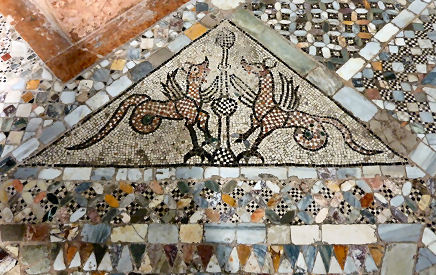
David Whittaker
Mindful of Venice Reflections and Meanderings
David Whittaker, having self-published a useful concise edition of
Coryate's Crudities a few years back has now, during
lockdown in
2020, published this volume of his own musings on aspects of Venice, with topics taking
in courtesans, horses, gondolas and deaths. To pick this book up
and flip through its pages is to need to buy it, due to it being so handsomely
produced and illustrated. In the first chapter Why Venice? the author gamely
mentions Henry James's famous quote about there being nothing new to be said
about Venice (but with its following, and less-quoted, qualification). And our
author has
also found a quote to the same effect from back in 1494! In the chapter on
English words that derive from Venetian I learned that ciao comes from the word
for slave, and in similar usages like 'at you service'. The point I'm
approaching is that no matter how much you think you know about Venice you'll
almost certainly learn something here, despite it working as a sterling introduction
too, and have the stuff you know refreshed. The only
miscalculation, for me, is the pages with a pair of black and white photos
between each chapter, which have added captions seemingly created by a random
meaningless/meaningful text generator. But apart from that...
Nicholas
Woodsworth
The Liquid Continent Volume 2: Venice
The blurb and the publicity for this book lead you to
expect a book that's all about 'Venice's love-affair with the sea'. But
this is more than a little cheeky as the 279-page book doesn't reach
Venice until page 107 and doesn't start discussing matters nautical until
page 177. This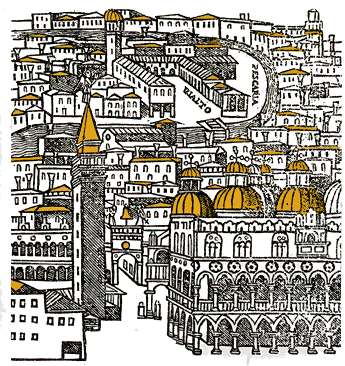 dishonesty aside it is a good read if you like travel
books. The opening chapters (or the pre-amble as it's known to
impatient Venice fans) progress along the Eastern Mediterranean coast and
around cities and ruins, offering insights and observations of
Mediterranean life and the range of characteristic Mediterranean
personalities. The Turkey bit
I liked a lot, but I've not read much about Turkey. Reaching Venice he
first keeps to the area around his apartment in Eastern Cannaregio, and
finally ventures into the wider and crowdeder bits. Venice the tourist
nightmare stars in this section, with the usual queues and crowds and
Murano glass ornaments like 'glazed vomit'. So far so not unpredictable,
if well and sharply described. The discussion of Venice's maritime history
and relationship with the sea, past and present, contains few surprises
for the well-read Venetophile either, but again the author marshals and
presents pretty well. dishonesty aside it is a good read if you like travel
books. The opening chapters (or the pre-amble as it's known to
impatient Venice fans) progress along the Eastern Mediterranean coast and
around cities and ruins, offering insights and observations of
Mediterranean life and the range of characteristic Mediterranean
personalities. The Turkey bit
I liked a lot, but I've not read much about Turkey. Reaching Venice he
first keeps to the area around his apartment in Eastern Cannaregio, and
finally ventures into the wider and crowdeder bits. Venice the tourist
nightmare stars in this section, with the usual queues and crowds and
Murano glass ornaments like 'glazed vomit'. So far so not unpredictable,
if well and sharply described. The discussion of Venice's maritime history
and relationship with the sea, past and present, contains few surprises
for the well-read Venetophile either, but again the author marshals and
presents pretty well.
|
|


Like no other city Venice encourages the creation of big and gorgeous books.
There's the glitz of the palazzi,
the grandeur of the Grand Canal, and the glowing colours of Venetian painting.
Heavily illustrated
and well produced books on these topics can't help but be objects of desire.
These plush tomes date back to the
late 1990s and so the earliest
days of my Veniceophilia and of this site.
|
|
These two
were as expensive as you'd think
|
|
These three weren't
|
|
Umberto Franzoi
& Mark Smith The Grand Canal
Arsenale Editrice 1993
This large slip-cased volume takes the form of a
photographic panorama recording the whole length of the Grand Canal, both banks.
The photographs were specially taken for the book (except the Ca' d'Oro pic
which has been pasted in, presumably because it was scaffolded over at the time
of the taking of the rest of the photos) and are gloriously bright and sharp. At
regular intervals it ventures into a full photographic portrait of a particular
palazzo, giving us glimpses of the grandeur within.
The text is informative, if a little lacking in sparkle, and can get a little
tedious and repetitive if you try to read it through cover-to-cover, but who
would do such a silly anal thing? Well, me actually. Later republished in a
disappointingly smaller format, but with a proper new photo of the Ca' d'Oro.
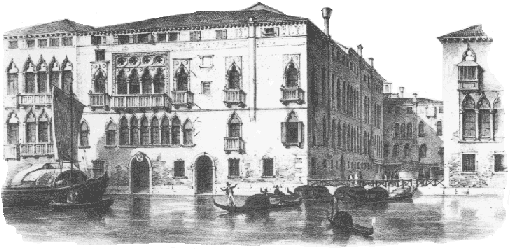
Alvise Zorzi & Paolo
Marton Venetian Palaces
Rizzoli 1990
In this one the major palazzi, on and off the Grand Canal, and
including the Doge's gaff, get photographed inside and out, art and details,
with some text giving their history, and the coats of arms of the families who
owned them. But it's the photographs that'll have you drooling.
|
|
Giandomenico Romanelli, ed.
Venice:
Art & Architecture Konemann 1997
Two truly
huge volumes, in a slip case, trace the history of art and architecture
in Venice from the city's foundation to the 20th Century. It does this
with a series of heavily illustrated essays on the various periods by various
contributors, and even covers the art of the book and weaving and glass.
Production values are high, as is the desirability quotient. And the essays
are even worth reading, if your arms can take it. Recently republished condensed
into one inexpensive volume to make it oh so easy to buy the book twice by
mistake.
Gianluigi Trivellato, et
al Venetian Palazzi
Evergreen 1998
Does a similar
job to the Zorzi volume (below left) but stays indoors, covers fewer palazzi,
and has mostly less-good, more flatly-lit, but still rather fine, photographs.
The exteriors are taken care of with some nice old prints - that's one of them
on the left - and with some contrastily
printed photographs strangely standing in for palazzi where prints where
presumably not available. But it's reasonably priced and very
worth owning if you're a palazzophile.
Andrea Fasolo & Mark E. Smith
Palaces of Venice Arsenale Editrice 2003
An alphabetical survey of the grander palazzi, and
not just those on the Grand Canal. The photos are by the same photographer as
the lovely Grand Canal book mentioned above and are a big draw. Unfortunately
they have to be the main draw as the text is so badly translated from the
Italian as to make it all but unreadable, unless you want some cheap laughs.
Which I'm always up for, so here goes: A recent and radical intervention of restoration has enabled to recover
the original readability of the Gothic building. And from the introduction:
Therefore it is not difficult to think that Venice's characteristic had held
a fundamental role in the exceptional mark that have always distinguished this
city from the others. So that's pretty clear then.
|

Venice
//
Florence // London
// Berlin
Home
|